
Shakespeare takes the simple route in The Tempest. He has Miranda tell us that it’s ‘raining-out’.
If by your art, my dearest father, you have
Put the wild waters in this roar, allay them.
The sky, it seems, would pour down stinking pitch,
But that the sea, mounting to the welkin’s cheek,
Dashes the fire out.
But we already knew that by the predicament of the seafarers in Act 1, Scene 1. There were portents and premonitions.

In developing Pibroch, I was always conscious that this was a project that had to integrate many media and levels of discourse. Its title conceit is musical but it is, centrally, a text – yet to research and shape the piece I found myself examining images. Images of hurricanes and bleached coral. Images of drought and torrential rain. Graphs and infographics. News reports and mobile phone footage. Images from satellites and adverts for deluxe refuges in obsolete nuclear missile silos.

And, of course, the available images of Piper Alpha before, during and after the night of the disaster on 6th July 1988 – of survivors, rescuers, family members, Occidental’s promotional footage, the pontifications of Tory ministers and Oil Industry executives.
But then a hurricane is not climate change. One cannot SEE climate change. It’s a process. Ida, Katrina or Tauktae are pixels in the pattern. To see the pattern we must learn to LOOK.
As I write, I can see the misty morning landscape beyond my window. I can see there is no sign of snow on this mild December day. If I chose to look, I could see news images of massive snowfalls in Northern California & Japan and floods in Malaysia. And always the droughts and the malnutrition, the violence and migration. To quote from Pump, part of the first movement of Pibroch:
Out there on the horizon.
Out there
later
not now
somewhere else.
Yet we are all collecting data. In a sense we are the data. Our experience and the way we jot things down – in selfies, snapshots, journal entries & witness statements, poems. We are the evidence of climate change. We (not I) integrate the ‘big picture’, join the dots, IMAGINE the process!
Don’t get me wrong. It is not that the process is imaginary. Climate Change is as real as we are. But it is only in the vast collage of data and imagery, experience and empathy that it can be seen. Even the many manifestations of Climate Denial or Delay are part of that process.
But how does this, seemingly kaleidoscopic, array of images become the landscape of a show, the setting of Pibroch? Make sense…or nonsense…of our current predicament? For it can only be OUR predicament…not yours or mine.
Of course, there are ‘practical’ issues in producing the show: copyright and intellectual property rights. Ethical issues of appropriation and exposure. The balance of impact versus authenticity, accessibility versus facticity. Not to mention the practicalities of bringing that visual language into the performance space with its real-world constraints of dimensions, lines of sight, lighting and power-sources.

But beyond these, I realised, there is a creative imperative to make the imagery FELT which demands LOOKING not just seeing.
And that, after all, is the primary discipline and virtue of graphic art – the necessity and wonder of looking. So, working closely with Graeme Roger of wildbird on the audio-visual design of Pibroch recently, I have been forced to look again and, maybe for the first time, to look deeply at the imagery that has shaped the work, imagery that has shocked or saddened me, outraged or appalled.

From calving icebergs to drowned children, remote sensing imagery of daily CO2 emissions to snaps of my parents’ wedding – how could we encapsulate, simplify and project these visual ideas into the performance space in ways that complement the words and music and the rapport between Arthur Coates and myself and the audience?
The visual design (so far) retains the text-mining maps I used to explore key texts like the Cullen Report or the various IPCC reports and includes public domain visualisations or satellite imagery of ‘global’ events.

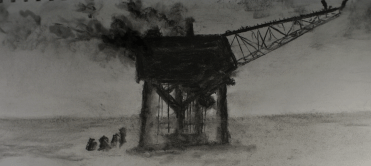
But the specific, FELT imagery – the subjective data-points tied to the expression of a refugee child, floodwater streaming through an Scottish village, crops shrivelled in desiccated fields and, of course, the twisted steelwork of Piper Alpha – these images demanded to be looked at, felt, re-presented. In charcoal, mostly. The recreation of my sense of this unfolding disaster scratched out in carbon.
What will survive into the finished piece on the 15th January will, of course, depend on a dense network of creative interactions and practical decisions over the course of the next few weeks, but the discipline, over the last few weeks, of sifting, simplifying and expressing these images has been immensely important.
The several ‘meditations’ on the Piper Alpha structure during and after the fatal explosions connect more viscerally to the burning and twisting, rupture and collapse – its angles and trajectories, the still seeping smoke, the amazement of flame as the riser ruptured.
And so too, the long meditation on children: how their faces might confront us in this adversity – in suspicion, rebuke, curiosity or shy laughter? The struggle for likeness but more so expression – the quicksilver flux of emotion (and therefore meaning) ‘behind’ the face and ‘behind’ the process.

Whilst the blizzard of ‘found’ (or force-fed) imagery leads to an overwhelm which is, ultimately, dispiriting – the creative distillation of individual images into a collective/still-subjective felt-sense allows us to work through the data to deeper levels of knowing. To levels which tap into kennings of love, grief, compassion, obligation. I’ve said elsewhere, Poetry is Activism in making the predicament (more) felt. So too then is image making and their reintegration into the work.


