
Pibroch developed out of a stalled idea. During the run-up to the Offshore Europe exhibition in Aberdeen and, specifically, planning for the Extinction Rebellion protests associated with that event, I was inspired by the idea of guerrilla piping in Aberdeen and the area around the exhibition centre – the incongruously named P&J Live.

The through-line for the idea was in summary:
- the awareness that, for my children’s generation, the Earth is a ‘burning platform’ demanding immediate and radical responses
- the deep local and industry awareness of the Piper Alpha Disaster in 1988
- the need to ground climate action in he local/ specific not the general, hence the vernacular choice of a pibroch played on the Highland Pipes and, specifically, Padraig Mor MacCrimmon’s Cloinne na Cumha (Lament for the Children).
It seemed to me that the idea blended an awareness of the dire predicament of my children and grandchildren generation – and, of course, billions currently living in the Global South – with the cultural experience of 2 generations of oil & gas workers in the North Sea who have lived with the knowledge of what happened on Piper (more or less) for the last 30 years.
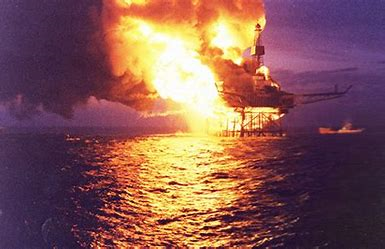
For those less aware of the Piper Alpha disaster, on the night of 6th July 1988 there was a large hydrocarbon release on the oil & gas production platform, 120 miles (190 km) North East of Aberdeen. The resultant explosion disabled the installation’s inadequate firefighting and emergency response capability and, in the course of the following 2 hours, 167 men (they were all men) perished – most whilst following instructions and awaiting rescue in the mess-hall.

Those who survived, in many cases, were those who disobeyed the prevailing wisdom and took their lives and their survival into their own hands.
My ‘guerrilla piping’ idea did not come to fruition. The focus was on ‘mass non-violent action’ around the exhibition venue itself – essentially a die-in on the slabs outside the building with the ‘traditional’ tense standoff between private security, Police Scotland and the rebels. The idea did not die, however, and, in the course of the following 2 years, the project which came to be called Pibroch developed.
It should be said, I wasn’t ‘on’ Piper Alpha that night…and had never been on that installation. In fact, I was then teaching in the South West of Scotland following redundancy during the first North Sea oil price slump of 1986 and a painful marital breakup. It was only in the wake of the Piper incident that I was encouraged to return to the North East and the oil & gas industry. I returned to Aberdeen before final publication of the public enquiry into the disaster – the Cullen Enquiry – but whilst oil companies and their engineering supply chains were frantically attempting to address the obvious systemic and technical failings that led to the disaster.
I had skin in the game then and I have skin in the game now.
I remember, during the early 1990s, at a conference in Aberdeen on Maintenance Engineering (my area then), a speaker calling the audience out…which of us had actually read the full report? Who knew what (actually) caused the disaster?
I felt vaguely virtuous in having read the exec summary. It was clear from the absence of hands raised that even that was a minority stake. The engaged conference attendees were operating on hearsay and preconception as they pursued increased revenue and profit for their businesses. How similar to the current climate crisis, I thought.
So, in approaching the development of Pibroch over 30 years later, I started with the ‘texts’. Who read the actual reports?

And, in the face of the vast body of text generated around Climate Change and its ecological and social impacts, how could one? This, after all, is what the IPCC processes have been all about – summarising and overwhelming body of evidence pointing (for the last 10 years at least) to the bloody obvious.
I did read as much as I could as well as reviewing ‘news feeds’ and ‘documentaries’ associated with both the Piper Disaster and the Climate Emergency. In addition to reading, I made heavy use of Infranodus’ Text Network Analysis tools to focus on differences in emphasis and terminologies between different genres and discourses. Looking at, for example, the difference between the dry technocratic reporting of the Cullen Report and the eyewitness testimony of survivors, I was struck by the essential incongruence of the two accounts…these were two language sets with minimal overlap.

And wasn’t that also true of the etiolated language of IPCC reports and those of other ‘interested’ agencies and the eyewitness accounts and experiences of those on the front line of the climate catastrophe. Yes: it was!
The immediate result of this process, which took well over a year, was a sequence of very angry spoken work pieces, intended to engage and impassion.
In 2020, I began developing ideas for a spoken word show incorporating words, music and visual elements with advice and support from Imogen Stirling, Hamish Napier & Mark Thomson whilst collaborating with Elizabeth Rimmer on editing and developing the work into a poetry collection for publication by Red Squirrel.
It has been a long, difficult project – not least because, time and again, it forced me to confront the horror of present climate impacts and frustration with the inaction, procrastination and outright malevolence of vested interests who resist necessary change.
In July 2021, I was grateful to Creative Scotland for the grant of monies to develop the rough idea of a Pibroch spoken word show into a ‘proper’ performance capable of touring in 2022. And, in the course of Autumn 2021, Sheila Wakefield & Gerry Cambridge of Red Squirrel Press have built on Elizabeth’s editorial insight to create a full collection – Pibroch – which, whilst complementing the spoken word performance, offers a broader and more nuanced view of the emotional and ethical responses to finding oneself on a ‘burning platform’.

The story of Pibroch’s development is documented in further detail in the Pibroch Artist Blog pages of this site.