Pibroch is coming to a place near you in the coming months – assuming you live in Scotland.
Thanks to the support of Creative Scotland and the National Lottery through their Touring Fund programme – and the continuing support of the Pibroch creative and production team – we’ll be taking the show to venues across Scotland between April and July of this year.
Kicking off on Sunday 2nd April at the Lemon Tree in Aberdeen as part of Climate Week North East, we’ll be visiting community venues, art centres and theatres in all corners of Scotland between now and our final performance at The Barn Arts Centre in Banchory on 6th July, the 35th anniversary of the Piper Alpha disaster.
Pibroch uses searing poetry created by Aberdeenshire-based writer and artist John Bolland, and mixes it with live music and striking visual imagery.
This multi-media performance represents the personal and social experiences of Piper Alpha survivors and their relationship to the challenges each of us face in a warming world – our very own burning platform – with a pressing need for change. It aims to inform, challenge and encourage that discussion.
Already we’re getting great press coverage in The Scotsman and Aberdeen Live. Tickets are onsale online for most of the venues, the set is built and van-ready and the team are excited to be going into final rehearsal at the Anatomy Rooms in Aberdeen next week.
16 out of the 17 programmed performances are now firmed up as shown on the map and listing below. The final venue is in the pipeline. Watch this space.
Pibroch On Tour – Confirmed Venues 20th March 2023
Ticket sales are also available through our Linktree site as they become available.
It’s all a bit daunting. Fourteen months ago we were still working out how to stage our premiere show at the marvellous Glenbuchat Hall, in mid-winter and amidst the COVID emergency. Today we’re ready to do it again in venues small and big across Scotland: 17 times!
Our tour programming explicitly aims to bring the show to places and communities affected by the Piper Alpha Disaster and the Climate Emergency. The post-industrial and remote island communities from which so many of the offshore workforce was drawn – many of which now face bearing the brunt of Climate Change and Climate Transition.
And, of course, copies of Pibroch – The Book are still available through this website or from its wonderful publisher at Red Squirrel Press.
Looking forward to seeing you seeing us sometime in 2023!
Poetry starts off in my mouth. Whatever the meaning or the metaphor, it is only on the tongue that it passes the test. I say the words…they seem to work…meaning, rhythm, order, meaning…a seasoning of assonance or rhyme. A recursive loop of articulation and meditation, the typed or scrawled text only a short-hand map to keep on track.
Pibroch was a very deliberate collection: a project based on a need to root the abstractions of climate politics in the experience of loss or recovery. To bring the traumatic suffering already endured on the frontiers of climate damage and poverty back home to the North, to my lived reality and living history. To find analogies and, I hoped, foster empathy. Kindness is my greatest hope in the coming decades.
And the performed poem – spoken word – is a vagabond. Escaped from its ‘book’ it shows up on any stage that it can find – bookshops,bars and coffee-shops, sometimes theatres, occasionally churches. It turns up and sings for its supper. Hoping to engage and entertain. Hoping to connect.
So the poems in the collection are very much about space and time: places and events and processes, recorded or forecast, global and local.
But, a show? A show is a very different thing. We called it a multi-media performance but it was a show. A show not a tell. A dialogue in the form of monologue that happens in its own space in the company of others immersed in an entanglement of music, light, sound, space.
I had always conceived of Pibroch ‘the show’ as a touring piece – a roving conversation migrating to whatever locality would listen and some that might not. I had a notion that this end would be best served by developing the show in a general-purpose social space: a community centre or church hall or, where I live, a village hall.
Glenbuchat Hall, Aberdeenshire
I had good personal reasons for settling on Glenbuchat. It is a magical place with a strong sense of community and a thriving music and arts scene based around local promoters and organisations like Glenbuchat Music, Eclectic Events and Art in the Buchat. Like all ‘remote’ locations it is the centre of its own universe with a particular can-do attitude and a generous soul.
But, for some of my professional theatre colleagues it must have seemed a perverse choice. No wifi, no public transport, allegedly no mobile phone signal (an unhelpful rumour). “Does it have running water”, one asked. Of course it does: fresh from the spring!
It did not have a flexible arrangement for rigging lights, a lot of electric power, a very big stage. And we had to accommodate COVID-19 restrictions when thinking about audience numbers, team accommodation and the arrangement of walkways.
The first time Simon Gane, Pibroch’s designer and production manager, looked at it, it was both exciting and daunting.
Glenbuchat Hall Interior
Challenge: how to create a special Pibroch world inside this space – a world that encompassed offshore oil platforms, hurricanes, rain forests, oceans and, indeed, the world itself.
We knew the show would depend heavily on projected imagery which complimented and added depth to the experience. We knew we would use sound effects and have the benefit of Fraser Fifield’s magnificent music to create and counter-point mood. But we had very little stage space and and every lighting-stand, stage-extension or set dressing ate into already limited audience capacity.
Simon, Brodie, Mark and Graeme went through many iterations negotiating a set design, lighting inventory and projection solution that satisfied as many of our aesthetic ambitions as possible. As a direct-address performance – poetry not theatre – Mark was insistent that Fraser and I (the poet-performer) be lit. But lighting needed not to wash-out the projected backdrop which must also be legible from the back of the hall. And it would be good not to trip the circuitry.
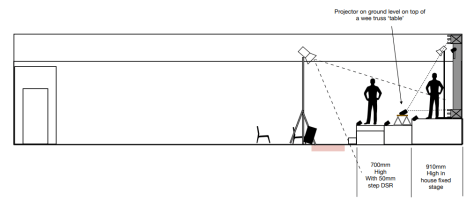
Pibroch Stage Design – Simon Gane
Simon’s eventual design was an elegant multi-variable optimisation and, for me, it was a huge satisfaction to be working on a stage with a sense of the scale of screen, my degrees of freedom and the location of the (well-managed) trip hazards. I realised I had not worked like this, in theatre, for over 35 years…whilst Mark reiterated that I was not an actor and we were NOT doing theatre.
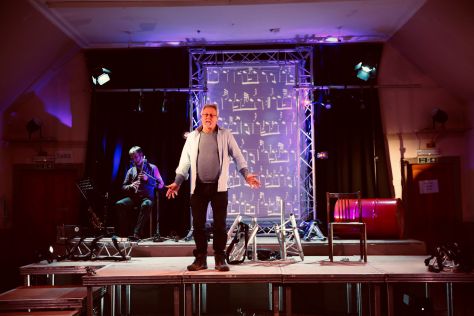
Pibroch – Trusses and Oil Barrel
It was at this point that various ‘random’ pieces of truss which seemed superfluous to the overall structure turned up. I had mentioned that I was keen to echo the sense of trusses on the fixed steel jackets of 1970s offshore oil platforms and especially the distinctive triangular bracing on Piper Alpha’s two remaining flare-booms. I didn’t realise, in the first few days of rehearsal, how effective these elements of Simon’s design would be. I was also sent to Banff to retrieve an oil drum…a stand-in for the eminence grease behind the production.
By Wednesday night, the show had a repertoire of gestures, moves, musical punctuation. A feel. Fraser and I did a complete run-through then left to allow Brodie and Martin Aitken, stepping in at the last minute, to rig the lighting and dress the set.
It was only as we worked through the tech, laboriously and meticulously setting levels and states, exploring transitions and balancing elements that I, at least, came to realise the richness of what we had created here. We had created a time and a space – a particular Pibroch-space in the specific real space of Glenbuchat Hall.
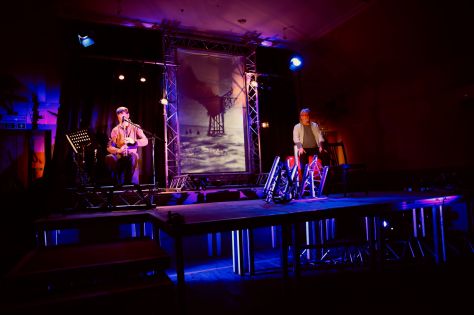
Hindcast – Photo by Graeme Roger
All that remained was to welcome an audience into that space and we did, ushering each into specific seating one metre apart. The first notes of Padraig Mor MacCrimmon’s Lament for the Children on Fraser’s pipes conjured a world.
As I write, Simon Gane and Brodie Murray are moving the truss for the staging up to the venue at Glenbuchat. This afternoon is the get in. The prequel to a week of rehearsal and, eventual, performance.
Over the last week I’ve been very conscious of the shift in effort and attention to detail involved in putting on a performance of this type.
Yes: I am used to the finnicky detail of editing poems – the notorious shifting and re-shifting of commas and nuancing of words – and the even greater scrutiny involved in proofing, typesetting and design. I have been blessed with a great publishing team in Sheila Wakefield, Elizabeth Rimmer and Gerry Cambridge at Red Squirrel Press who share a passion for perfection and vast amounts of patience.
And I am familiar with the excruciating attention involved in printing and painting – especially in portraiture – where a millimetre displacement or an increment of hue can make or break a piece.
But, as a writer and visual artist, I’ve never had to worry much about COVID risk assessment, feeding the crew, the availability of First Aiders: let alone whether anyone can actually see or hear me!
Glenbuchat Hall, a real space
And yet here Pibroch is, in a real space – Glenbuchat Hall in West Aberdeenshire – at a real time – a Saturday night in January in the second year of a global pandemic – working with real people – performing to real people – with musical accompaniment by Fraser Fifield and visuals developed in collaboration with Graeme Roger – in a setting created by Simon Gane.
And we are ready and it has come together through the skills and effort of all of the team, not least the directorial inputs of Mark Thomson, the support of Martin Aitken, marketing nous of Lucy Stroud and mentoring of Lesley-Anne Rose of Open Road Ltd.
The journey from idea to text to a visual concept has been long but these last weeks have been intense. How do we make these ideas and elements play, in an exciting and engaging manner, within the real space? Where do I stand? How do I avoid getting in the way of projection? Am I lit – visible – audible – ‘appropriate’?
I began with naïf assumptions about the space – especially the stage – the options for lighting and projection (and exit routes and social distancing) but, day by day, the team has solved and resolved each issue – proposing, critiquing, collaborating, reworking.
Vertical Projection in Growth
A key design decision was to use a vertical rather horizontally aligned projection mode (think portrait rather than landscape). This played off of the available stage area and the projector throw necessary to achieve appropriate height to width ratios.
And the stage footprint – and no-go zones defined by the projection beams – constrained the lighting opportunities and, as I am sure will emerge, where I can actually ‘be’ on the stage at any moment in the performance.
Our decision not to use a stage mic frees me from the stand – and the simplifying constraint of a single narrow footprint as in cabaret performance. But now I am interacting with the lights, the projection beam and the challenge of not falling off the stage whilst speaking the text in a relaxed, powerful and (ideally!) coherent and audible manner. Hmm. I’m not sure I’m in Kansas anymore.
I have previous theatrical experience – I know how to find a light and follow notes – project and present. But, after almost a decade of working and performing as a poet and spoken word performer, it feels like this new project has taken my experience and practice to a new level of discipline and sophistication. All of which I owe to the Pibroch team who have acted not only as enablers to the work but patient mentors in each aspect of the craft. They have my eternal gratitude.
It was an idea and now it’s possible…and that is the art. A week from now we will be striking the set in that space and looking for future programming opportunities for Pibroch through 2022.
I have been working on this project since Autumn 2019 and I can honestly say – I am excited!
Watch this space for more updates as the week progresses.
Shakespeare takes the simple route in The Tempest. He has Miranda tell us that it’s ‘raining-out’.
If by your art, my dearest father, you have Put the wild waters in this roar, allay them. The sky, it seems, would pour down stinking pitch, But that the sea, mounting to the welkin’s cheek, Dashes the fire out.
But we already knew that by the predicament of the seafarers in Act 1, Scene 1. There were portents and premonitions.
Credit : NASA
In developing Pibroch, I was always conscious that this was a project that had to integrate many media and levels of discourse. Its title conceit is musical but it is, centrally, a text – yet to research and shape the piece I found myself examining images. Images of hurricanes and bleached coral. Images of drought and torrential rain. Graphs and infographics. News reports and mobile phone footage. Images from satellites and adverts for deluxe refuges in obsolete nuclear missile silos.
Credit : Survivalcondo.com
And, of course, the available images of Piper Alpha before, during and after the night of the disaster on 6th July 1988 – of survivors, rescuers, family members, Occidental’s promotional footage, the pontifications of Tory ministers and Oil Industry executives.
But then a hurricane is not climate change. One cannot SEE climate change. It’s a process. Ida, Katrina or Tauktae are pixels in the pattern. To see the pattern we must learn to LOOK.
As I write, I can see the misty morning landscape beyond my window. I can see there is no sign of snow on this mild December day. If I chose to look, I could see news images of massive snowfalls in Northern California & Japan and floods in Malaysia. And always the droughts and the malnutrition, the violence and migration. To quote from Pump, part of the first movement of Pibroch:
Out there on the horizon.
Out there
later
not now
somewhere else.
Yet we are all collecting data. In a sense we are the data. Our experience and the way we jot things down – in selfies, snapshots, journal entries & witness statements, poems. We are the evidence of climate change. We (not I) integrate the ‘big picture’, join the dots, IMAGINE the process!
Don’t get me wrong. It is not that the process is imaginary. Climate Change is as real as we are. But it is only in the vast collage of data and imagery, experience and empathy that it can be seen. Even the many manifestations of Climate Denial or Delay are part of that process.
But how does this, seemingly kaleidoscopic, array of images become the landscape of a show, the setting of Pibroch? Make sense…or nonsense…of our current predicament? For it can only be OUR predicament…not yours or mine.
Of course, there are ‘practical’ issues in producing the show: copyright and intellectual property rights. Ethical issues of appropriation and exposure. The balance of impact versus authenticity, accessibility versus facticity. Not to mention the practicalities of bringing that visual language into the performance space with its real-world constraints of dimensions, lines of sight, lighting and power-sources.
Credit : Simon Gane
But beyond these, I realised, there is a creative imperative to make the imagery FELT which demands LOOKING not just seeing.
And that, after all, is the primary discipline and virtue of graphic art – the necessity and wonder of looking. So, working closely with Graeme Roger of wildbird on the audio-visual design of Pibroch recently, I have been forced to look again and, maybe for the first time, to look deeply at the imagery that has shaped the work, imagery that has shocked or saddened me, outraged or appalled.
Infranodus Text Modelling
From calving icebergs to drowned children, remote sensing imagery of daily CO2 emissions to snaps of my parents’ wedding – how could we encapsulate, simplify and project these visual ideas into the performance space in ways that complement the words and music and the rapport between Arthur Coates and myself and the audience?
The visual design (so far) retains the text-mining maps I used to explore key texts like the Cullen Report or the various IPCC reports and includes public domain visualisations or satellite imagery of ‘global’ events.
Credit : Peter Glenn
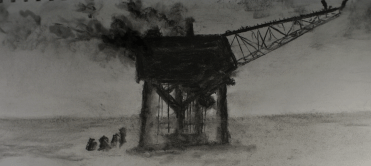
But the specific, FELT imagery – the subjective data-points tied to the expression of a refugee child, floodwater streaming through an Scottish village, crops shrivelled in desiccated fields and, of course, the twisted steelwork of Piper Alpha – these images demanded to be looked at, felt, re-presented. In charcoal, mostly. The recreation of my sense of this unfolding disaster scratched out in carbon.
What will survive into the finished piece on the 15th January will, of course, depend on a dense network of creative interactions and practical decisions over the course of the next few weeks, but the discipline, over the last few weeks, of sifting, simplifying and expressing these images has been immensely important.
The several ‘meditations’ on the Piper Alpha structure during and after the fatal explosions connect more viscerally to the burning and twisting, rupture and collapse – its angles and trajectories, the still seeping smoke, the amazement of flame as the riser ruptured.
Piper Alpha 7th July 1988
And so too, the long meditation on children: how their faces might confront us in this adversity – in suspicion, rebuke, curiosity or shy laughter? The struggle for likeness but more so expression – the quicksilver flux of emotion (and therefore meaning) ‘behind’ the face and ‘behind’ the process.
Whilst the blizzard of ‘found’ (or force-fed) imagery leads to an overwhelm which is, ultimately, dispiriting – the creative distillation of individual images into a collective/still-subjective felt-sense allows us to work through the data to deeper levels of knowing. To levels which tap into kennings of love, grief, compassion, obligation. I’ve said elsewhere, Poetry is Activism in making the predicament (more) felt. So too then is image making and their reintegration into the work.
Pleased to be reading new work from Pibroch at the May online event for the fabulous Poetry @ Books & Beans in the company of the marvellous Sheila Templeton reading from her new collection, Clyack, published by Red Squirrel Press.
Pleased to be reading as part of the STEM group of poets in the great company of Eveline Pye, Colin Will, Mandy Haggith, Elizabeth Rimmer, Chris Powici, Leela Soma, Lesley Traynor, Gill Ian and Joe Murray.
The first in a programme of events exploring the beneficial links between poetry and the sciences especially in the context of the current climate emergency.