
By the mid-sixties, family life had settled to a rhythm which was peculiar for our class and time. We were, nominally, thanks to John’s wages from the car-plant, members of the ‘affluent working class’.[i] We lived in modern council housing. John earned a decent wage augmented by a pattern of constant night shift and taking the regular overtime available on Friday and Sunday night.
In the summer of 1967, Mary was heavily pregnant again.[ii] Nevertheless, she packed up the trunk with clothes and foodstuffs[iii] and dispatched it as freight to Braeside in anticipation of our holiday. By then, Mary was leasing one or other of the houses at Braeside for all of July, taking my three brothers away immediately school term finished. She rented the Wee Hoose for the first fortnight in July then the Big House for the Glasgow Fair, during which time her brothers rented the Wee Hoose. A month away or more. John accompanied us down to Arran on the first weekend then went back to work, leaving Mary, her mother and myself to mind the brood.
The house next door to Braeside was owned by old Mrs. Urqhuart whose son and adopted son brought their families to stay for the same month. Bill Urqhuart was a bluff sweetie-wife of a man with a beautiful, gentle-seeming wife, Jenny.[iv] He had 2 sons who played rough and tumble games – and cricket and were generally better than us at sports. The other – adopted – son, Danny Cullen, was some sort of an entrepreneur from Strathaven with a cuddlesome wife, Moira, with whom I would later become infatuated.
Although short-sighted, I was already ‘bookish’ by then[v]. Around 1967, however, my bookishness was restricted, to Commando comics and Illustrated Classics.

Aunt May had been trying for some years to encourage my literacy with Christmas gifts of the Adventures of Robin Hood, Children of the New Forest and Moby Dick (unabridged). Actually, I preferred books with pictures: [vi] Commando comics satisfied the appetite for post-war triumphalist patriarch propaganda: slant eyed villains and evil krauts. The genre never embraced our Soviet allies as warmly as one might expect for we were deep in the Cold War verities of Mutually Assured Destruction by then[vii].

Better than Commandos, however, were the Illustrated Classics series which could be purchased (pocket money permitting) from the newsagent in Whiting Bay. The Iliad, The Corsican Brothers, Silas Marner, Black Beauty. I conned the ‘plot’ and characters of each without having to worry about the wine-dark sea. Knew stuff. [viii] Better still: a walk down to the village for comics (and messages) afforded the opportunity to plead for an ice-cream float at the café at the foot of the Kiscadale Burn or a pony ride at the swing-park at Sandbraes.
I was a fantasist: dreaming epic adventures that transcended my physical weakness and wrapping myself in the aegis of Achilles, Hector, D’Artagnan and Ishmael.
*
Despite the island’s propensity to drizzle, my memory of summer childhood is, of course, hot with clegs and midges.
Water ran down the rough dirt track of the Barn Road like a burn. As we approached Sandbraes, the lush forest on either side of the track, the running water and the heat, stickie-willies and clegs flet tropical (so far as any of use thought we knew the tropics). My grandmother would call it the Burma Road. Second hand memories of the war in South East Asia were still vivid[ix].
The High Road was more passable, with only a few dips susceptible to flooding. Each journey to the village or Sandbraes, along tree lined and thicketed tracks was an imaginable adventure with Japs lying in ambush and tigers roaming in the deep gullies.
Fantasy filled the space of….what? Shame probably.
We could have socialised more, as children: but we didn’t.
We could not join the SUSM[x] – which organised activities for children among the dunes at Sandbraes: we were catholic.
The Urquarts were never close as they continually beat us at games.
The kids at the farm at the top of Braeside track didn’t fraternise with holiday makers.
My cousins – Isobel and Cathy – were girls: and older.
Apart from the occasional stroll up to the gully to throw our trash into the burn, I was always and only waiting for my father.
John only had two weeks leave from the car-plant – at the Paisley Fair – which left him at home alone in Paisley, for most of July, except at the weekends.
Foregoing overtime, he would catch the morning train from Canal Street each Friday morning after work, take the Glen Sannox from Ardrossan to Brodick and step down off of the Lennox bus at the foot of the Auchencairn Road.
On those mornings, I’d wait and watch anxiously for sight of him, climbing up the brae from Oakbank, his golf-bag slung from his left shoulder, his holdall in his right fist. At first sighting, my brothers and I would race up the stony track then down the metalled road, across the bridge, to meet him at the corner by Black’s Farm. We’d compete to carry the heavy bag of clubs as we escorted him back up the road. If he was already fu’, which he generally was[xi], I dreaded my mother’s wrath, the embers still warm under the ash of the week passed. We never got that he had just completed a twelve-hour shift. That he was, essentially, nocturnal.
John stayed until Sunday, slept late, played golf on Saturday and Sunday lunchtime. Understandably, he was keen to be on the golf-course most days: he was on holiday! But, at least in the early days, he acquiesced to visits to the beach at Sandbraes, an evening walk to Kings Cross, the Glen Ashdale Falls or the standing stones at Largie Beag.
Best of all was the fishing, though the fishing was a big ask. We pestered him for ages, a promise extracted then, finally, delivered after days or weeks of evasion. A man and three boys in a boat. A father and three sons. It was £5 for the hire of boat and tackle for an evening.

It is my most precious collage of memory. John sits on the middle thwart of a rowing boat. A nipped cigarette is stowed behind his ear. His feet are spread and the corded muscle in his forearms flex as he leans forward and, at the perfect moment, hauls back. The heavy oars drip brine between each stroke. He has thick sideburns and a grim yet joyful expression. Focussed.
A calm sea. A deep-blue evening sky. The air cooling towards a dew. The water beneath the keel transparent. Strands of thong-weed float up, miraculous, from the sandy bottom.
Between his spread legs, there is a box of fish and gear. Orange and green handlines wind around old wooden frames, each dressed with a 3-hook pater-noster rig. Two cod and a haddie, and a plaice, a handful of saithe flap and gape. The smell of dead fish. Bait slime. Bilge water. Broken shells.
We wore no lifejackets. McKenzie supplied king scallops for bait. The big, flat shells rattled empty in the bait-box after we had split them, carved off the meat and set it on the hook. The shells seemed too marvellous to throw overboard and yet too common-place to keep.
Brian and Charles, sit in the bow, spying out our course back towards Old Man McKenzie’s jetty. . Every four strokes, my father glances behind him, correcting his course. Nell, McKenzie’s crazy collie, is not barking on the jetty. The pair of them have gone home, trusting us to stow away the anchor, oars and rowlocks, put the handlines in the shack, draw the boat up on the shingle-beach.
Once, a basking shark passed a few feet from the boat while we were fishing. Once, a submarine surfaced, alarmingly close, its black hull radiating steep waves as it powered forward, oblivious to us. Once, John hauled a huge cod up from the depths, only for the hook to straighten and the fish escape, with a last flick of its tail, back through the green into the darkness.
On the steep shingle, my father threaded orange tow through the gills and gaping mouths of the fish we had caught and we took turns to carry the catch, up through the bracken and hawthorn, along the edge of pastures, across the burn and up the Auchencairn Road to Knockankelly. The sun set over the Sleeping Warrior.
For me, at 9, this was who he was and when he was: being with us as we learned the things we ought to learn, teaching us to row, to fish, to venture out onto the sea, to stow away the gear, considerately. To gut and dress and cook and eat the catch: like a sacrament.
Apart from this curated memory and a few sunny glimpses, my father is a recurring absence – a herring-bone pattern of departure and re-entry imposed on the timeline of my childhood.
His rounds of golf ended in the 19th hole. The Whiting Bay club house, empire of the redoubtable Betty Black, became our ‘local’[xii] As children, we were always keen to ‘meet Dad off the course’ rather being left under the supervision of our grandmother whilst Mary went to meet him. .
He was a good golfer. Handicap of 1 or 2. He played for the work’s team at Linwood and for the West of Scotland, in tournaments and outings: the Scottish Open (when it was still Open). He competed in the regular Medal competitions at Whiting Bay. The prizes were usually plaques and crystal ashtrays. There was a rosebowl you had to give back the next year, a precarious trophy with four boisterous sons in a Paisley tenement flat.
That is the other memory of his benign power. Feet apart, knees bent, eye on the ball. The way his hips and shoulders swung the wood back then drove it down-around in a graceful arc. Those long arms must have been some sort of an advantage. The crack that dissolved the ball into the distance, far away down the fairway towards the green.
Replace your divot, pick up your tee, proceed.
This beautiful pointlessness he tried, but failed, to teach me.
My Elliott uncles enjoyed a round of golf but not with John’s drive and devotion. I doubt if they played a round when they were not on Arran. [xiii]
The memory of my mother on Arran during this time has been erased[xiv]. I retain these vivid images of my father: on the Auchencairn Road, at Kingscross or the Golf Course. I cannot see my mother. Lunch and (maybe) dinner were my grandmother’s domain: chicken & noodle soup (Knorr) and lumpy custard with a thick skin. Rolled ox tongue.
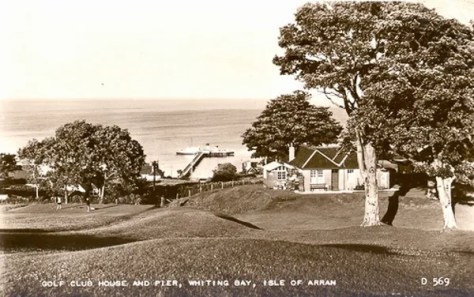
As we grew older, the plea to ‘meet Dad off the course’ was replaced by the plea to accompany the adults to the club house. There was no longer any pretence that he would be coming home any time soon and it was a right of passage, to participate in those evening family excursions to Whiting Bay club-house, leaving my younger siblings under my grandmother’s care.
Men with golf-gamps and women with brollies, we stravaiged along the High Road to beyond North Kiscadale then through the narrow gate and across a very dubby field to the wooded gorge of Allt Ceirde, which we called the Fairy Glen. The gully there was deep and sheer, with waterfalls above and below the narrow footbridge. Beyond the gully, another dubby path edged along the Eastern boundary of the golf course to the metalled road and the Club House.
Inside, the summer Clubhouse was full of locals and regular ‘country members’. Among the locals there was the postie, George, and the McSporrans (John & Hamish)[xv], Eric Wood, a resident market gardener[xvi] and Betty Black, club secretary and matriarch. The country members were mostly doctors and lawyers, schoolteachers, who kept a second holiday-home in Whiting Bay where they spent long summer holidays. Danny & Moira Cullen were also frequent.
John’s prowess at golf – and his general bonhomie and liking for drink – dissolved class-barriers (a bit). Four boiler makers down and three sheets to the wind, he was comfortable and cheerful company. His long term friendship with quiet local men like George and Eric suggests a depth and quiet to his friendship which I never saw: a decency.
Mary, on the other hand, constantly fretted that the doctors and lawyers, owning their own big villas and their flashy cars, thought that they were better than us.
Whilst the men sat around tables, drinking and, occasionally, playing dominoes, the women – Mary and my aunts, Cathy and Margaret, drank whisky macs and fed the puggie. Only Betty really sat in on the men’s tables, trading dram for dram and always another set up at her elbow[xvii].
If the path across the Fairy Glen was dubby in day light and sober, it was a marvellous adventure in the pitched dark with all the adults tipsy and some, especially my father, moroculous. Now the golf-gamps became indispensable to men like Tommy and Sammy, picking a safe route forward through pitch-blackness or the glance of torchlight over rocks and shough, the waters of Allt Ceirde rushing left or right or left and right.
One night, according to Tommy, he discovered my father, who had led the way, clinging to a branch at the edge of the path, his body dangling over the splash pool below the falls.
“What are you doing down there?” he asked.
O how they laughed!
Afterwards, cheese and toast (with sliced tomatoes) at the fireside in the Wee Hoose, Tommy (agnostic and contermatious) delighted in demolishing John’s arguments (and my beliefs) on topics from Religion to Politics to History. I loved the fireside debate but the sense that John, generally fu’, could not defend his position against Tommy’s deft but self-evident sophistry was always a downer. I hated Tommy’s (proclaimed) agnosticism – his willingness only to demolish, not to build – and the latitude this gave him in debate, always to be in the right, if might is right.
Then again: the cheese on toast was very good.
*
For years, Mary sustained her privilege of a full month or more at Braeside: two weeks more than her siblings and more than anyone in Foxbar would presume. But the Sinclair grandchildren grew up and their own generations shifted to other places with other Fair Fortnights – Paisley, Renfrew.
Choices had to be made. The Elliotts retained their rights to the Wee Hoose for the Glasgow Fair. The Bollands were exiled from Knockenkelly. You could think it was rational, given numbers of children and modesty of requirements: but it probably wasn’t.
From then, ‘dispossessed’, we rented where we could, at market rates.
One year in Mrs. Waysons dark little cottage set in deep woods in Glenashdale at the Southern extremity of the Bay. It was a damp, dreich summer with dodgy electrics though the cottage was closer to the golf course for my father.

Another year, the holiday cottage at the back of the Cameronia, where my parents long relationship with the Cammy began and where I fell in love with one of Magnus Magnusson’s daughters.[xviii] On top of early adolescent romance (and bowling out Magnus at cricket), the summer of the Cameronia was magical: a place actually on the seafront that allowed me to could roam all day along the shoreline, exploring rockpools for stranded marvels: rockling and sea scorpions, hermit crabs and sea urchins. I fished beyond the sandbar for tiny plaice and flounder with a 6d net. Searched for agate, jasper and smoky quartz among the shingle North of the Kings Cross burn. Grasped (almost) the nature of intrusive dykes that split the sand stone slabs on the foreshore at Mid-Kiscadale.
That summer my theoretical engagement with the natural world – gleaned form Look & Learn, Encyclopaedias and catalogues – suddenly became practical.[xix]
These years of peripatetic exile extended into my mid-teens. Mary never considered going anywhere else. Not even another of the resorts on Arran. Others among the ‘affluent working class’ experimented and settled for Majorca or the Costa del Sol. Mary remained fixed on Whiting Bay as though her whole will and ambition was devoted to getting back there as often as possible for as long as possible. Nothing else mattered or perhaps ever would.
Notes
[i] Those were the years of the ‘affluent working class’ and Linwood car-workers were among Scotland’s poster-boys of that phenomenon. Like the Clyde shipyards, in the early part of the century, the ‘new industry’, nurtured and sustained by Labour Government subsidies, paid significantly higher wages than comparable local industries.[i]
Young men, drawn from the ailing Govan shipyards, boosted the population in the housing estates of Paisley, Johnstone and, especially, Linwood. Schooled in the Clydeside culture of high earning, closed shops and union activism, Linwood workers, during the car plant’s brief existence, had disposable income, better housing than the 19th century tenements they had been brought up in, improved educational opportunities for their children, attitude. Constant night-shift and lots of overtime yielded a good wage-packet (though he took his share before handing it over).
[ii] Their fourth and last child, Raymond, had been born in August: I remember the ambulance drivers carrying Mary up to the tenement from the end of the cul-de-sac.
[iii] Especially tinned ham, peaches, fruit cocktail, blocks of jelly.
[iv] Yes: just like the Raeburn painting.
[v] Both my grandmothers ascribed my short-sightedness to reading – they warned me against it: that and the square eyes I’d get from watching television. We had television in Foxbar by then but there was never television at Braeside. We were on holiday from the evils of civilisation.
[vi] I have always been more interested in assimilating knowledge (or at least facts) than narrative.
[vii] I did find a copy of the book – The War Game – a spin off from the banned BBC docu-drama – in the Big House. It must have been left by one of the older Sinclair children. My mother was very insistent that I should not be reading that stuff: so, of course, I did.
[viii] My maternal grandmother continued to bring me a copy of the Beezer (only me) on her regular visits to Foxbar but by then, in my own opinion, I was far beyond the Beezer, the Beano or the Hotspur. (I did quite like Dan Dare).
[ix] In fact, John Sinclair, the eldest of the Sinclairs of Braeside had served in Burma during World War 2, so not so second-hand for some of us.
[x] Scripture Union Seaside Mission
[xi] The bar on the ferry opened on departure from Ardrossan.
[xii] John was also a habitue of the Royal, the Cameronia, the Whiting Bay, Eden Lodge, the Kiscadale, the Brodick Bar and the Ormidale.
[xiii] Just as, apparently, they rarely drank when not on holiday.
[xiv] Or, one glimpse, she sunbathed, sclathered in coconut oil, so that she tanned to a dark crisp. In shorts and vest top – star-fished out of a canvas deckchair.
[xv] Sons of an Italian family who changed their name during the war. Hammy was a fine baritone.
[xvi] though originally from Yorkshire
[xvii] One night, after a long session and having locked up the clubhouse in the dark, Betty slipped and fell on the steps, breaking her ankle. She walked home – a distance of about half a mile. When she got home – she lived alone – she discovered the bone sticking through the skin of her leg.
[xviii] They holidayed in the Burlington or the Argentine. She was a minx and my first amour since Renee Dailly.
[xix] If only in the Victorian sense of an avid collector of specimens: specimens which generally died in the jar or the bucket.