
As part of Climate Week North East, Pibroch will be returning to the North East for a reflective exhibition and discussion – Reflecting on a Future Dance.
Tag Archives: Climate Change
Pibroch
As part of Climate Week North East, Pibroch will be returning to the North East for a for a performance in Johnshaven Village Hall in collaboration with NEAT.

We need to talk about Desire…
Consumptioun first appears in Scots literature around 1500 CE[i].
These early uses carried the sense of ‘using up’ through wear, destruction or wasting.
The term was most commonly used to refer to what is now termed ‘pulmonary tuberculosis’ until economists appropriated the term,[ii]
The pathological nature of consumption is, therefore, recognised from the very beginning. Consumption is not synonymous with nurture or stewardship. Consumption is a devastation. We are wasting away: we are wasting the Earth.
And yet, during the 18th and 19th centuries, consumption (i.e. tuberculosis) was romanticised in Europe.[iii] Consumption ‘was identified as a disease which promoted beauty in women and “conferred beauty upon its sufferer.” The waiflike consumptive was “dramatically pale and ethereally thin with the red cheeks and bright eyes of fever.” It was fashionable to look this way and, eventually, became a way of being “with damaging implications for women’s physical and mental health,” as well as their societal roles.’[iv]
As ‘consumers’ we literally use up the world. But we know the Earth’s material resources and capacity to absorb pollution – including Greenhouse Gases are finite. Consumption will tip our climate into states we have never experienced as modern humans.
The figure below succinctly illustrates the choices which confront us.

Yet, especially for the affluent 10%, our consumptive state – with its ease, freedom of choice and luxuries – remains seductive. Like the ‘waxen cheeked’ consumptives of the begining of the Industrial Age, we are in danger of dying whilst wallowing in the ‘beautiful illusion’: the aptly named ‘White Plague’.
Footprints
Since the beginning of the 19th century, human beings have consumed/wasted more and more. The progress of this wasting accelerated soon after the Second World War.[iii]

Energy consumption is rising globally and in most regions of the world. But these ‘national’ aggregates are misleading. Clearly, use (or even availability) is not equally distributed at an individual level. Some areas with high consumption are not reducing demand. Other areas with already very low per capita consumption have little impact in terms of incremental growth in consumption.

Personally, my current carbon footprint is calculated to be about 3.64 tonnes of CO2 per annum. This is about half the UK average and about 60% of it is driven by my diet according to the United Nation’s algorithm[v].

Of course, it wasn’t always like this. For most of my life I worked in the oil industry, commuted to work by car (single occupancy) and frequently travelled by air both regionally and internationally[vi].
But carbon footprint calculations are only a partial, single-issue indicator of the demands our individual and collective consumption impose upon Earth’s resources.
2019 figures from a recent bp review illustrate how energy is used across different sectors of the notional word economy. The orange block – Industry – is energy converted to emergy – energy embedded in products.
In 2017, the human population consumed 88 billion tons of Earth’s natural resources.
- Biomass: 22.5 billion tonnes
- Fossil fuels: 15 billion tonnes
- Metal ores: 9.1 billion tonnes
- Non-metallic minerals: 41.7 billion tonnes
That is over 11 tons of natural resources for every single person on Earth. We are consuming the Earth far more quickly than life on Earth can reproduce itself, whilst ores and fossil fuels are essentially finite resources within ‘human’ timescales.

In 2023, Earth Overshoot Day – the day human consumption exceeded the Earth’s productive capacity – fell in August. Every year it is getting earlier![vii]
And, as always, consumption is unequally distributed between individuals, within communities and between different regional societies. Some regions. communities and individuals never have an Earth-day. Others outstrip planetary capacity many times over[viii].

The lifestyle of the ‘average’ UK resident demands about 2.6 Earths. Of course, no-one is average and the UK currently has as high a level of ‘in-country inequality’ as it did during the Belle Epoque. Climate-responsibility is based on wealth and the resource-intensity of our current lifestyles and those of our ancestors.
Slaves/ Addicts
We can’t/unlearn the comfort we derive/from warmth (or coolness), the thrill of speed, the ease of traction powering the plough. Pibroch 2022
The power that fossil fuel consumption releases creates ‘goods’ with immediate benefits in terms of comfort, ease and capability.
Another way of looking at our consumptive lifestyles is provided by an ergonomic perspective on the roles fossil fuels play in many of our lifeways.
Prior to the 18th century, societies primarily depended upon human or animal labour to provide all forms of motive power.
One barrel of oil is equivalent to approximately 11 years of human labour.[ix] Sawing, digging, running, lifting, thinking. Since the 1750s, our fossil-fuelled power tools have disconnected us from the physical effort our ‘standard of living’ requires in their absence. The ‘average’ US citizen consuming 61 barrels of oil equivalent every year commands the equivalent of 700 fossil slaves[aa].
A recent article in The Conversation[x] suggested that our health and well-being would be greatly enhanced if we could emulate aspects of hunter-gatherer lifeways.
The specific elements contributing to well-being were identified as:
- A plant based diet
- Regular fasting
- Movement e.g. walking 6-16km/day
- Living in small egalitarian groups
- A sense of connection and meaning
The work that the hundreds of fossil slaves each of us exploit work against these healthier lifeways.
What I really, really want…
So what do we really want, and is that consistent with the energy and other resources we consume in our daily lives?

Maslow’s hierarchy of needs emerged as a favoured model of ‘human’ behaviour in the late 1940s, just as the post war acceleration in fossil fuel emissions was taking off[xi]. Initial growth rates – of 5% per annum in Europe – were, in part, driven by post-War regeneration and a reaction to the restrictions, austerities and colonial exploitation of preceding decades. Individuals wanted goods which they had been deprived of in the austerities of depression and war, even to the extent of prioritising lost luxuries over basic sustenance.
But consumer demand – and the aspiration to affluence – was also required to fill the additional productive capacity created during the war years, especially in America. Simply restoring and meeting peoples functional needs was no longer sufficient to feed the beast. Maslow’s hierarchy mapped out motivational drivers which the emerging advertising industry exploited.[xii].[xiii]

But how should we invest resources between needs and wants?’ Are only the wealthy to have cakes and ale – as was commonly the case in the pre-modern period? How do we choose between needs, social expectations and desire?
Priorities across regions and cultures vary. Space cooling in the Arabian Peninsula is, obviously, a greater priority than space heating. Saudi Arabia has the oil-rich option. Oil poor India must prioritise cooking and heating water.

In the ‘average’ week in 2018, the ‘average’ UK household spent almost £500 on stuff and services[xiv].
Among the big ticket items in alignment with Maslow hierarchy are food (12%), shelter (housing and fuel – 15%), love and belonging (recreation and culture – 15%).
The Office for National Statistics’ (ONS) categories used above which don’t fit so comfortably with Maslow’s hierarchy are Transport(16%) and Restaurants & Hotels (15%). We are, it seems, a society on the move, spending 31% of our weekly budget on ‘getting around’.
Of course, as above, no-one is average: many will only have enough for food, shelter and a bit of love & belonging: if they are lucky.

Consolidating these ‘average’ figures, somewhat approximately[xv], into one or other of Maslow’s categories[xvi] yields a distribution of ‘disposable income’ as shown here.[xvii]
The UK model is probably unusual, compared to global norms, in that safety (security & defence), education and health are largely provided by the state (out of taxation) rather than household disposable income to an unusually high degree.

If we, factor government spending (per household[xviii]) into this analysis in order to reflect non-discretionary expenditure on health, education and safety, the allocation of resources per British household looks like this.[xix] :
So the ‘average’ UK households ‘allocation’ of monetary resources in a week in 2018 would look a bit like this:

The ‘average’ UK household’s ‘consumption’ of food, floorspace, heat & light may be far in excess of their physiological needs, of course[xx]. And an element of expenditure of clothing might be legitimately physiological, though the paradigm of fashion, fast or otherwise, suggests its primary drivers are esteem and belonging.

Source: bp Energy Review 2023
Mobility (AKA Transport) represents a significant element in our consumption and yet, according to BP’s figures, it is the least decarbonised of consuming sectors. (In fact, transport forms an even greater part since large transportation inputs are disguised in food-stuffs, clothing and manufactured goods due to the global nature of supply chains.)
Mobility apart, it might feel that the ‘average’ UK household is over-investing in esteem and self-actualisation until we consider non-discretionary spending ‘on our behalf’: then we might reasonably feel under-invested. Others, of course, don’t have that ‘luxury’…but perhaps they achieve these personal and social goods in other, less commodified ways.
My personal impact, therefore, depends on
- what I consume,
- how it is produced,
- where it came from,
- how much I consume
- how I manage the waste
- what I allow the state to do with my taxes
Challenges and Opportunities
Different goods and services have different resource-intensities and, specifically, carbon-intensities.
One cannot compare apples and oranges: in fact, one can’t even compare avocados and avocados.
How they were produced and where and how you consume them – and what you do with the waste afterwards – have a massive impact on your individual consumption.
Audiences and sources in the course of the 2023 Pibroch tour offered a range of insights, perspectives and challenges associated with each of the categories above. These are explored in the links below.
Safety
Love and Belonging
Esteem
Mobility
Cognitive
Aesthetic
Self actualisation
What is clear from those insights is that the weekly ‘carbon-basket’ – or perhaps the weekly ‘survival basket’ – is malleable and we, collectively, have considerable agency over our present and future impacts.
The con
One comment repeated in Pibroch post-show discussions was essentially “advertising drives everything.” We are persuaded to want and consume more, even to the extent of negoitating unaffordable credit to enable immediate consumption.

The Great Acceleration[xxi] after World War 2 saw a massive escalation in CO2 emissions globally.
I have written elsewhere about the correlation and divergence of population and GDP growth based on the work of Thomas Pickety[xxii].
The Kaya identity is a mathematical index based on the insight that the total emission level of the greenhouse gas carbon dioxide can be expressed as the product of four factors:
- human population,
- GDP per capita,
- energy intensity (per unit of GDP)
- carbon intensity (emissions per unit of energy consumed)[xxiii]

As can be seen, slight improvements (i.e. reductions) in Carbon Intensity and Energy Intensity over the last 60 years have failed to balance the rapid growth in both Population and per capita GDP. Growth – in both of these dimensions – drives CO2 emissions drives climate change. And remember, the average UK citizen consumes 2.6 Earths per annum – the average Indian citizen only consumes 0.8.[xxiv]
The con is that we are encouraged, by constructs of fashion and innovation, to buy more and more stuff. New gadgets generate new desires demand more energy. Changes in ‘fashion’ drive the replacement and discard of perfectly functional objects: clothes, cars, toys in pursuit of ‘distinction’.
We know our current resource-use trajectory is unsustainable. Yet, especially in the Global North, our patterns of consumption are driven by desire not need : or more precisely, our need for esteem and individuation is over-invested to an extent that the very existence of our communities are threatened. Meanwhile, patterns of mobility (transmission issues) consume a disproportionate share of household income.
Waste
Waste is the ‘dark matter’ in our patterns of consumption.
All the goods that we ‘consume’ have a waste-footprint which contributes to our overall carbon footprint.
Mapping of energy flows in the US, for example, illustrated that two thirds of the potential energy generated in the USA in 2022 was essentially wasted in production and transmission.

The many comments on waste that emerged from the Pibroch discussions included:
- modern machinery and appliances are not designed to be repaired.
- all ‘discarded’ functional products should be returned to manufacturer who should be obliged to ensure their reuse
- supermarkets should be forced to publish their levels of waste
- if food waste was a country it would have the 3rd highest carbon footprint after China and the USA
- consumers might prefer outlets with lower wastage rates
- different types of food contribute different proportions to the overall carbon footprint. More waste in high carbon food types will cause greater warming
Some elements of waste arise from the production process but a significant proportion relates to the disposal of still functional objects or surplus perishable goods.
For example…
FOOD WASTE : In 2018, households in the UK wasted 6.6 million tonnes of food.
CLOTHING WASTE : In the UK ,we buy more clothes per person than any country in Europe. Around 300,000 tonnes of useable clothes are burned or buried in landfill each year.[xxv]
DIGITAL WASTE : If someone stores ten terabyte of images, games or video on the cloud, using data storage, they create a carbon footprint equivalent to half a tonne of CO2e. per annum[xxvi]
WASTE ELECTRICAL & ELECTRONIC EQUIPMENT : 5.3 billion phones were thrown away in 2022. One 226g phone needs 74kg of raw materials, and the production of one microchip requires 36 litres of water.[xxvii] The average mobile device has a usable lifespan of 7 years. On average, consumers replace their phones every 3.6 years. Only 12% of phones are recycled. 80% of the parts in a phone are recyclable.[xxviii]
STORAGE : In a survey of middle class Los Angelinos, US Anthropologists discovered that 50% could no longer park in their 2 or 3 car garages because they were devoted to the storage of their ‘stuff’[xxix]. Those cherished clothes you’ll never wear again are ‘wasted’: neither consumed nor recycled but demanding new production, to meet needs and desires, by their ‘absence’.
In recent decades we have seen major drives to increase the levels and efficacy of recycling as a way of mitigating resource intensity. The concept of the Circular Economy as originally promulgated was summarised in the 4Rs (Reduce, Reuse, Recycle, Recover). Since 2008, however, publications, especially from practitioners and consultancies, have revised the 4Rs to 1R (Recycle)[xxx].
Reuse and recycling have been a feature of human societies for millenia: gifting and hand-me-downs have extended the life of stuff beyond the limits of function and desire. Heirlooms were social capital. In the early modern period, clothes and fabrics were handed down over generations (and gratefully received). These are cultural features, culturally conditioned.
Although levels of recycling have increased dramatically, levels of consumption have outstripped them. We are still not recycling anywhere near as much as we consume. It is evident from the examples above that recycle is not having the impact on resource use that we need.
Reduction in the level of overall consumption AND waste will be a major contributor to mitigation of climate change. Subsumed in reduction, perhaps, is a 5th R – replace. Or, more precisely, substitute where new ‘purchases’ are required. Different elements of our diet of food and clothing, for example, have different carbon-footprints. Substituting beans for beef or linen for wool have significant impacts on the resource intensity.

Is there a future?

The last IPPC report (2023) forecast future global temperatures based on a range of possible societal trajectories from time-now, specifically in relation to energy use and GHG emissions:
There is a global scientific consensus (greater than 99%) that a rise in ‘average’global temperatures above 1.5 degrees compare to the pre-industrial period will cause more extreme storms, droughts, flooding, crop failures and disease in all regions.
The IPCC assessment of our current patterns of consumption (and the governmental policies that support them) suggests that we are not on track to reduce consumption, even of fossil fuels. Illustrative pathways are categorised in terms of a range of strategic societal responses to the Climate Catastrophe[xxxi].

Each illustrative pathway exhibits different profiles – different trade-offs between
- demand reduction,
- fossil fuel phase out
- substitution of fossil fuels by renewables.
But, by the simple laws of physics, material use (and emergy) must flatline and pollution fall to zero to achieve sustainability (even at our currently degraded state).[xxxii]
Demand reduction, however, is the pathway in which individuals, households and communities have the greatest agency. Other pathways depend upon the foresight and willingness of corporations and nation-states who, to date, show little appetite for the necessary change.


The climate impact comparison of current policies being pursued (CurPol) and Demand Reduction (IMP-LD) are illustrated here [xxxiii].
How can we, as WEIRD individuals and households, go about reducing consumption in ways to best contribute to an aggregate global reduction in demand, not only for energy generated by fossil fuel combustion but also other vital resources including biomass and ores?
Is there a past?
Scotland’s first oil boom lasted from the 18th into the mid-20th century. Crews from the whaling station at Bunabhainneadar on Harris killed and dismembered thousands of blue and fin whales between 1904 and 1951, generating 80,000 barrels of oil. [7]
The Bunabhainneadar station was a Norwegian business, relocated there after the Norwegians had effectively exterminated all of the whales from Northern coastal waters.
During the Pibroch conversations, it was repeatedly pointed out that the UK and Scandinavian governments are doing good compared with other countries such as China and Russia. It was remarked that ‘we shouldn’t be too hard on the UK Government’.
But a careful accounting of the material footprint for several nations, including those embedded in international trade, demonstrates that between 1990–2008 period, no country achieved a planned, deliberate economy-wide decoupling for a sustained length of time. Claims by the Global North to the contrary conceal the substantial offshoring of its production, and the associated ecological devastation, to the Global South.[xxxiv]”[9]
This strand of the discourse, around present and future consumption by individuals and communities, is mirrored in a second strand which focusses on historical Climate Responsibility – or perhaps better, Climate Guilt.
It is not only current lifeways but also national histories which have different carbon intensities.

British industrialists and colonists were prime movers in industrialisation, mechanisation and extractive capitalism.
By 1830, British imports of cotton, wood, and sugar required the exploitation of more than 10 million hectares of cultivable land – 1.5 to 2 times all the cultivable land available in the UK.[10]
Since 1850, Britain’s former colony, USA, has released more than 509 Gigatonnes of CO2 and is responsible for the largest share of historical emissions : over 20% of the global total.
China is a relatively distant second to the USA (11%), followed by Russia (7%), Brazil (5%) and Indonesia (4%). The latter pair are among the top 10 largest historical emitters due to CO2 from land use and deforestation[xxxv].
The UK’s European neighbours (which make up the European Union) are also large historical contributors at 22% of historical emissions.
Together, the US, Russia, Germany, the UK, Japan and Canada currently account for 10% of the world’s population but 39% of cumulative emissions since 1850. In historical terms these WEIRD Northernerns are 4 times more guilty than the average Human. In comparison, China, India, Brazil and Indonesia account for 42% of the world’s population but just 23% of cumulative emissions 1850-2021.
Large annual emitters & producers today – such as India, Brazil or Saudi Arabia – are not large contributors in a historical context.
There is an evident resistance, however, to accept responsibility for the actions of our ancestors: actions which, for some of us, at least, enable our consumptive lifeways in the present. Whilst the Bible advises that the ‘sins of the father’ will be visited upon on their children to the third and fourth generations[xxxvi] – which takes us back to about 1860 in my case – the presentism of contemporary culture shirks historical accountability at a regional and planetary level.
For example, the current UK government believes “trying to unpick our history is not the right way forward” with respect to slavery reparations to the countries of the Caribbean. The current Prime Minister – Rishi Sunak – rejects calls to apologise and pay reparations. [xxxvii]
Conclusion
“Folk need to remember – and some still do – that it wasn’t always like this. For example, the ratio of cars to households in Liverpool in the 1980s was 1 per 9 households.”
It was pointed out during the Pibroch conversations that ‘there is a tension between Energy as a Commodity (the dominant force in modernity) and Energy as Commons’. The same is surely true of the hydrosphere, the lithosphere, the atmosphere, the cryosphere and bioproductivity: commons which are shared within and across biomes.
Interconnectedness is the compelling lesson of Climate Science yet individualism (and atomisation) are the dominant paradigm of modernity : private spaces, private interests, private property.
The wasting disease of consumption is propagated by the over-stimulation of ungratified desires, hungers that rot in the fridge, evanescent dress-codes, the desire to be different and keeping up with Jones who we never really speak to.
And always the need to travel: the rutted sea routes and contrails, the motorway tailbacks, the unpaid commuting overhead.
It has been said that, in an idyllic (peasant) past, a person died ‘saturated with life’. Folk died with purpose, even if it was only that they had become elders, except in time of pestilence. Now, the unsatisfiable tick-list of desires promotes the idea of the bucket-list: you will be unfinished if you don’t do/have this/that- and you won’t.
Collaborative consumption, through associations such as cooperatives, libraries of stuff, hand-me-downs, local producers and 15-minute communities offer models to reduce aggregate consumption and also nurture critical and ethical scrutiny of waste in the production of goods (the ‘supply chain’).
Just say: YES.
Boycotts offer end-users, working in association, the power to adjust the resource intensity of collective lifeways.
Just say: NO.
But we need to deepen and expand critical climate literacies, both in this generation and the next. Food (or product) labelling still embeds the paradigm that “I am too hurried/stressed/hashed to think much about it.” We need space, time and conversation to really get to grips with our individual patterns of consumption and what triggers drive them.
And we need to integrate the moralistic and hedonistic perspectives of ‘our nature’: be persons (hedonistic) in association (moralist), be communities that care.
[i] Dictionaries of the Scots Language:: DOST :: consumptioun (dsl.ac.uk)
[ii] The term consumption traces back to Latin, consumere, to ‘take together’ but, from the outset, it was associated with the illness labelled phthisis in Classical Greek which referred to ‘any disease that causes wasting of the body’. Ancient Greek φθίσις (phthísis, “consumption, decline, wasting away”), from φθίω (phthíō, “I waste away”). phthisis – Wiktionary, the free dictionary
[iii] Even in death she is beautiful: Confronting tuberculosis in art, literature and medicine (abdn.ac.uk)
[iv] Ibid
[iii]
Energy consumption, and especially fossil fuel combustion, took off as
1)corporations resorted to advertising to fill ‘productive’ capacity developed for military purposes
2)(partially) decolonised regions attempted to catch up with the standards of living of the erstwhile colonial powers.
[v] United Nations online platform for voluntary cancellation of certified emission reductions (CERs) (climateneutralnow.org)
[vi] And I still eat meat (that big dietary contribution to my footprint).
[vii] Overuse of Resources on Earth (theworldcounts.com)
[viii] How many Earths? How many countries? – Earth Overshoot Day (footprintnetwork.org)
[ix] The Oil Drum: Europe | What is a Human Being Worth (in Terms of Energy)?
[aa] Based on human labour rates of $20/hr, a barrel of oil should be worth $200,000. Of course, at $1.90 a day, it’s only worth about $3000.
[x] How living like a hunter-gatherer could improve your health (theconversation.com)
[xi] The Empire of Things, Frank Trentman.
[xii] At the turn of the millenium, Thomas Haufe suggested a societal model for design evolution in the period since World War 2.[xii]

This model has been used to explore the parallels between design evolution and Maslow’s hierarchy of needs.
An interpretation of these models of ‘human centred design’ is that the production of new ‘stuff’ – and therefore our consumption of energy and materials – increasingly focussed on aesthetic, status or individualising features. Safe and functional technologies to meet most of our physiological needs were already available in the 1950s.
In this regard, industrial and service design deliberately commodified status, individuation and desire in order to drive increased resource consumption: a trend intensified by the targeting algorithms of big data on the internet.
[xiii] Maslow’s rule of thumb reflects a moralistic strand in philosophy. Needs should be satisfied before wants (or desires). But, across different cultures, there is also a hedonistic-libertarian strand. Studies of low income labourers in China in the mid-20th century found they spent a ‘disproportionate’ proportion of their income on socialising and festivals. Spectacular hospitality – for example Indian weddings – illustrate that many lower income households prioritize belonging and esteem over physiological or security needs. Trentam ibid.
[xiv] This figure excludes expenditure on professional services, taxes, mortgage interest payments & insurances. Figures are per household not per capita.
Family spending in the UK – Office for National Statistics (ons.gov.uk)
Expenditure – Office for National Statistics (ons.gov.uk).
[xv] The rough categorisation is documented in the table below. I accept that the choice to assign tourism to self-actualisation rather than mobility (for example) is rough & ready.
[xvi] Maslow’s Hierarchy of Needs (simplypsychology.org)
[xvii] ONS ibid
[xviii] There were 27.6M households in the UK in 2018
[xix] I have allocated public order, defence and social protection to safety, education to cognitive, health, housing and personal social services to physiological and transport to mobility. Numbers Game, February 2018 | Public Finance
[xx] I find it interesting that, in the UK, safety & cognition (education) (and health) are not regarded as discretionary expenditure and have been abrogated to the state who define who and what is kept safe and, to an extent, what and how we ‘know’.
[xxi] Great Acceleration – Wikipedia
[xxii] Capital and its Discontents
[xxiii] Emissions by sector: where do greenhouse gases come from? – Our World in Data
[xxiv] Meanwhile, CO2, though the most long lived are not the most pernicious of the greenhouse gases. Methane release is also rising inexorably. Agricultural emissions of NO2 show a similar trend.
[xxv] WRAP-valuing-our-clothes-the-cost-of-uk-fashion_WRAP.pdf, Sustainability of the fashion industry (parliament.uk)
[xxvi] What is the Carbon Footprint of Data Storage? (greenly.earth)
[xxvii] This Is Why Mobile Phone Recycling Matters (compareandrecycle.co.uk)
[xxviii] Mobile Phone Recycling Data – The Numbers – MobiCode
[xxix] Trentam ibid.
[xxx] Conceptualizing the circular economy: An analysis of 114 definitions – ScienceDirect
[xxxi] Interactive: The pathways to meeting the Paris Agreement’s 1.5C limit (carbonbrief.org)
[xxxii] Growth, Vaclav Smil
[xxxiii] Ibid
[xxxiv] Wiedmann et al., 2015
[xxxv] The low level of Land-use contribution to the UK’s carbon footprint since 1850 probably reflects the fact that the land was already deforested before 1800.
[xxxvi] Deuteronomy 5:9-10
[xxxvii] Slavery: Rishi Sunak rejects call to apologise and pay reparations – BBC News
Pibroch in 2024
We’re excited to announce the first performance date for Pibroch in 2024.

We’ll be performing at Johnshaven village hall, in Aberdeenshire, on the 20th March, the first, we hope of a number of shows over the year. Thanks to the community promoters at Johnshaven and to NEAT for inviting us to stage the show and engage in discussion there.

The next evening, 21st March, will see us at Fittie Community Hall in Aberdeen (or more precisely Fittie) for our exhibition/ discussion piece – Pibroch – Reflections for a Future Dance as part of Climate Week North-East 24.
Reflections for a Future Dance is a distillation of experiences from our 2023 Pibroch tour, using previous audience feedback, visuals, music and spoken word as a basis of conversation and inspiration for further meaningful interventions in the Climate Emergency.

It builds on the blog series – What I heard about Climate Justice in… and the subsequent set of reflective pieces we’ve been blogging since December last year.
Reflections for a Future Dance is part of this year’s amazing Climate Week Nort East programme coordinated by NESCAN. Catch up with all the events in the brochure at CWNE 2024 brochure-FINAL.pdf (hubspotusercontent-eu1.net)
We launched our 2023 tour as part of CWNE 2023 so it’s great to be back to share our learning and insights.

As always, with Pibroch, it’s all about the conversation. Reflections for a Future Dance is free but please book a place at Pibroch – Reflecting on a future dance. Tickets, Thu 21 Mar 2024 at 19:00 | Eventbrite so we know how many to expect!
Tickets for Pibroch at Johnshaven are £10/£7 and are available from Johnshaven Stores or at neatshows.co.uk… Oh, and bring your own bottle (if you want)!


Pibroch 2023 Tour
2 weeks to go!
Pibroch is coming to a place near you in the coming months – assuming you live in Scotland.
Thanks to the support of Creative Scotland and the National Lottery through their Touring Fund programme – and the continuing support of the Pibroch creative and production team – we’ll be taking the show to venues across Scotland between April and July of this year.
Kicking off on Sunday 2nd April at the Lemon Tree in Aberdeen as part of Climate Week North East, we’ll be visiting community venues, art centres and theatres in all corners of Scotland between now and our final performance at The Barn Arts Centre in Banchory on 6th July, the 35th anniversary of the Piper Alpha disaster.
Pibroch uses searing poetry created by Aberdeenshire-based writer and artist John Bolland, and mixes it with live music and striking visual imagery.
This multi-media performance represents the personal and social experiences of Piper Alpha survivors and their relationship to the challenges each of us face in a warming world – our very own burning platform – with a pressing need for change. It aims to inform, challenge and encourage that discussion.
Already we’re getting great press coverage in The Scotsman and Aberdeen Live. Tickets are onsale online for most of the venues, the set is built and van-ready and the team are excited to be going into final rehearsal at the Anatomy Rooms in Aberdeen next week.
16 out of the 17 programmed performances are now firmed up as shown on the map and listing below. The final venue is in the pipeline. Watch this space.

2nd April – Lemon Tree, Aberdeen
22nd April, Peterhead Theatre, Peterhead
1st May – Lyth Art Centre, Wick
3rd May, Lochinver Village Hall
4th May – An Lanntair, Stornaway
5th May – Balivanich Community Hall, Benbecula
6th May – Braes Community Hall, Skye
19th May – Harbour Arts, Irvine
20th May – The Beacon, Greenock
23rd May – Catstrand, New Galloway
4th June – Scottish Story Telling Centre, Edinburgh
6th June – Gardyne Theatre, Broughty Ferry
7th June – The Byre, St. Andrews
Ticket sales are also available through our Linktree site as they become available.
It’s all a bit daunting. Fourteen months ago we were still working out how to stage our premiere show at the marvellous Glenbuchat Hall, in mid-winter and amidst the COVID emergency. Today we’re ready to do it again in venues small and big across Scotland: 17 times!
Our tour programming explicitly aims to bring the show to places and communities affected by the Piper Alpha Disaster and the Climate Emergency. The post-industrial and remote island communities from which so many of the offshore workforce was drawn – many of which now face bearing the brunt of Climate Change and Climate Transition.
And, of course, copies of Pibroch – The Book are still available through this website or from its wonderful publisher at Red Squirrel Press.

Looking forward to seeing you seeing us sometime in 2023!


Suddenly it all seems very real.
Only 4 weeks to go!

Box-office links to the Pibroch launch at the Lemon Tree in Aberdeen on 2nd April – and the other 15 performance dates – are up on our linktree page.
It is now over a year since the play’s first performance in Glenbuchat, a year spent planning and adapting the work for the demands of a national tour. A year spent sustaining existing relationships and building new ones through emails and zoom meetings – shared folders in the cloud – individual effort meshed into a well-thought-out plan.
It was a delight to welcome Karen Tennent and Jane Hamilton to the team and to continue my working relationships with Mark, Martin, Simon, Graeme, Fraser and Brodie. And we are grateful for the continuing support of Creative Scotland enabling us to make the plan happen.
The last six months has seen a meticulous piecing together of the elements: through venue & travel bookings, set design and build, identification of improvements, social media and marketting and, in my case, yoga and voice exercises!
But this week we turned a particular corner, at Standing Ovation’s secret location on the edge of the Cabrach, most of the team converged to work together fitting up Karen Tennent’s design, constructing it, testing it, dismantling it and making sure it would fit in the van.

Simon Gane’s and Brodie Murray’s physical realisation of Karen’s design ideas is awesome. It’s concrete and flexible, elegant in its simplicity and ingeniously devised. And it works!
We tested the projector – sometimes key-stoning seems harder than the metal work to tune – but not in Graeme Roger’s capable hands. Months of ‘virtual’ decision making:
“Yes, that’ll work!”
“OK, let’s do that.”
And suddenly it is real. And it does.
Yes – there is still magic to be added – light, music, the words – but Thursday 4th March Pibroch passed another milestone. Now, a short (but busy) march towards the rehearsal room and the stage.

The locations of the 16 scheduled performances is shown in the map above. Check in on our linktree site to find dates and use the QR Code below to access our online programme.


We’re Touring!
So! The drum roll moment…Pibroch will be touring Scotland in 2023!
Thanks to the support of Creative Scotland and the National Lottery through their Touring Fund programme – and the continuing support of the Pibroch creative and production team – we’ll be taking the show to venues across Scotland between April and July of this year.
Our Producer, Martin Aitken, has been working hard in the back ground to set up performances at venues big and small across Scotland and tickets are already on sale at a number of the venues.
The creative team have already begun work n what we can learn from the performances of 2022 and how the show can be improved. Karen Tennent, joining the team as set designer, has already proposed new and exciting ideas for the staging of the show – accommodating the need to get-in, get out and move on within tight deadlines and in a variety of spaces ranging from the Byre Theatre in St. Andrews to Linaclate Hall in Benbecula
14 out of the 17 programmed performances are already firmed up as shown on the map and listing below. Others are already in the pipeline.

2nd April – Lemon Tree, Aberdeen
20th April – Mareel, Lerwick
1st May – Lyth Art Centre, Wick
4th May – An Lanntair, Stornaway
5th May – Balivanich Community Hall, Benbecula
6th May – Braes Community Hall, Skye
19th May – Harbour Arts, Irvine
20th May – The Beacon, Greenock
23rd May – Catstrand, New Galloway
24th May – Moffat Town Hall
4th June – St. Mary’s Cathedral, Edinburgh
6th June – Gardyne Theatre, Broughty Ferry
7th June – The Byre, St. Andrews
6th July – The Barn, Banchory
Ticket sales will also be available through our Linktree site as they become available.
It’s all a bit daunting. A year ago we were still working out how to stage our premiere show at the marvellous Glenbuchat Hall, in mid-winter and amidst the COVID emergency. Today we’re planning to do it again : 17 times!
And our tour programming explicitly aims to bring the show to places and communities affected by the Piper Alpha Disaster and the Climate Emergency. The post-industrial and remote island communities from which so many of the offshore workforce was drawn – many of which now face bearing the brunt of Climate Change and Climate Transition. If your community would be interested in hosting one of the few remaining slots, please get in touch. Under the terms of the touring fund, the costs to communities could be as low as venue hire for the event or less.
Frazer Fifield & I will also be offering additional creative writing and music workshops in parallel with the tour: exploring writing and music in the context of the Climate Emergency. If interested, again, please get in touch.
And, of course, copies of Pibroch – The Book are still available through this website or from its wonderful publisher at Red Squirrel Press.
Looking forward to seeing you seeing us sometime in 2023!


Pibroch-World

Poetry starts off in my mouth. Whatever the meaning or the metaphor, it is only on the tongue that it passes the test. I say the words…they seem to work…meaning, rhythm, order, meaning…a seasoning of assonance or rhyme. A recursive loop of articulation and meditation, the typed or scrawled text only a short-hand map to keep on track.
Pibroch was a very deliberate collection: a project based on a need to root the abstractions of climate politics in the experience of loss or recovery. To bring the traumatic suffering already endured on the frontiers of climate damage and poverty back home to the North, to my lived reality and living history. To find analogies and, I hoped, foster empathy. Kindness is my greatest hope in the coming decades.

And the performed poem – spoken word – is a vagabond. Escaped from its ‘book’ it shows up on any stage that it can find – bookshops,bars and coffee-shops, sometimes theatres, occasionally churches. It turns up and sings for its supper. Hoping to engage and entertain. Hoping to connect.
So the poems in the collection are very much about space and time: places and events and processes, recorded or forecast, global and local.
But, a show? A show is a very different thing. We called it a multi-media performance but it was a show. A show not a tell. A dialogue in the form of monologue that happens in its own space in the company of others immersed in an entanglement of music, light, sound, space.
I had always conceived of Pibroch ‘the show’ as a touring piece – a roving conversation migrating to whatever locality would listen and some that might not. I had a notion that this end would be best served by developing the show in a general-purpose social space: a community centre or church hall or, where I live, a village hall.

I had good personal reasons for settling on Glenbuchat. It is a magical place with a strong sense of community and a thriving music and arts scene based around local promoters and organisations like Glenbuchat Music, Eclectic Events and Art in the Buchat. Like all ‘remote’ locations it is the centre of its own universe with a particular can-do attitude and a generous soul.
But, for some of my professional theatre colleagues it must have seemed a perverse choice. No wifi, no public transport, allegedly no mobile phone signal (an unhelpful rumour). “Does it have running water”, one asked. Of course it does: fresh from the spring!
It did not have a flexible arrangement for rigging lights, a lot of electric power, a very big stage. And we had to accommodate COVID-19 restrictions when thinking about audience numbers, team accommodation and the arrangement of walkways.
The first time Simon Gane, Pibroch’s designer and production manager, looked at it, it was both exciting and daunting.

Challenge: how to create a special Pibroch world inside this space – a world that encompassed offshore oil platforms, hurricanes, rain forests, oceans and, indeed, the world itself.
We knew the show would depend heavily on projected imagery which complimented and added depth to the experience. We knew we would use sound effects and have the benefit of Fraser Fifield’s magnificent music to create and counter-point mood. But we had very little stage space and and every lighting-stand, stage-extension or set dressing ate into already limited audience capacity.
Simon, Brodie, Mark and Graeme went through many iterations negotiating a set design, lighting inventory and projection solution that satisfied as many of our aesthetic ambitions as possible. As a direct-address performance – poetry not theatre – Mark was insistent that Fraser and I (the poet-performer) be lit. But lighting needed not to wash-out the projected backdrop which must also be legible from the back of the hall. And it would be good not to trip the circuitry.
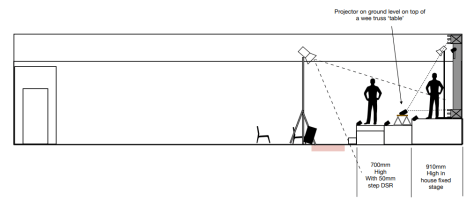
Simon’s eventual design was an elegant multi-variable optimisation and, for me, it was a huge satisfaction to be working on a stage with a sense of the scale of screen, my degrees of freedom and the location of the (well-managed) trip hazards. I realised I had not worked like this, in theatre, for over 35 years…whilst Mark reiterated that I was not an actor and we were NOT doing theatre.

It was at this point that various ‘random’ pieces of truss which seemed superfluous to the overall structure turned up. I had mentioned that I was keen to echo the sense of trusses on the fixed steel jackets of 1970s offshore oil platforms and especially the distinctive triangular bracing on Piper Alpha’s two remaining flare-booms. I didn’t realise, in the first few days of rehearsal, how effective these elements of Simon’s design would be. I was also sent to Banff to retrieve an oil drum…a stand-in for the eminence grease behind the production.
By Wednesday night, the show had a repertoire of gestures, moves, musical punctuation. A feel. Fraser and I did a complete run-through then left to allow Brodie and Martin Aitken, stepping in at the last minute, to rig the lighting and dress the set.
It was only as we worked through the tech, laboriously and meticulously setting levels and states, exploring transitions and balancing elements that I, at least, came to realise the richness of what we had created here. We had created a time and a space – a particular Pibroch-space in the specific real space of Glenbuchat Hall.
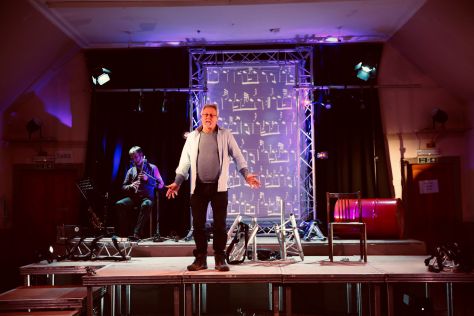
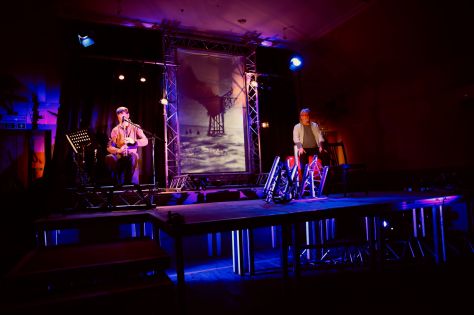
All that remained was to welcome an audience into that space and we did, ushering each into specific seating one metre apart. The first notes of Padraig Mor MacCrimmon’s Lament for the Children on Fraser’s pipes conjured a world.


Pibroch Book Launch – Scottish Poetry Library, Edinburgh
The Pibroch Collection, published by Red Squirrel Press, will be launched at SPL on Saturday 26th February. Copies available from this website, Red Squirrel Press or on the night. Looking forward to a great day reading with the fabulous Helen Boden launching her collection, A Landscape to Figure In, and Stirling Makar, Laura Fyfe.

The Art of the Possible
As I write, Simon Gane and Brodie Murray are moving the truss for the staging up to the venue at Glenbuchat. This afternoon is the get in. The prequel to a week of rehearsal and, eventual, performance.
Over the last week I’ve been very conscious of the shift in effort and attention to detail involved in putting on a performance of this type.
Yes: I am used to the finnicky detail of editing poems – the notorious shifting and re-shifting of commas and nuancing of words – and the even greater scrutiny involved in proofing, typesetting and design. I have been blessed with a great publishing team in Sheila Wakefield, Elizabeth Rimmer and Gerry Cambridge at Red Squirrel Press who share a passion for perfection and vast amounts of patience.
And I am familiar with the excruciating attention involved in printing and painting – especially in portraiture – where a millimetre displacement or an increment of hue can make or break a piece.
But, as a writer and visual artist, I’ve never had to worry much about COVID risk assessment, feeding the crew, the availability of First Aiders: let alone whether anyone can actually see or hear me!

And yet here Pibroch is, in a real space – Glenbuchat Hall in West Aberdeenshire – at a real time – a Saturday night in January in the second year of a global pandemic – working with real people – performing to real people – with musical accompaniment by Fraser Fifield and visuals developed in collaboration with Graeme Roger – in a setting created by Simon Gane.
And we are ready and it has come together through the skills and effort of all of the team, not least the directorial inputs of Mark Thomson, the support of Martin Aitken, marketing nous of Lucy Stroud and mentoring of Lesley-Anne Rose of Open Road Ltd.
The journey from idea to text to a visual concept has been long but these last weeks have been intense. How do we make these ideas and elements play, in an exciting and engaging manner, within the real space? Where do I stand? How do I avoid getting in the way of projection? Am I lit – visible – audible – ‘appropriate’?
I began with naïf assumptions about the space – especially the stage – the options for lighting and projection (and exit routes and social distancing) but, day by day, the team has solved and resolved each issue – proposing, critiquing, collaborating, reworking.

A key design decision was to use a vertical rather horizontally aligned projection mode (think portrait rather than landscape). This played off of the available stage area and the projector throw necessary to achieve appropriate height to width ratios.
And the stage footprint – and no-go zones defined by the projection beams – constrained the lighting opportunities and, as I am sure will emerge, where I can actually ‘be’ on the stage at any moment in the performance.
Our decision not to use a stage mic frees me from the stand – and the simplifying constraint of a single narrow footprint as in cabaret performance. But now I am interacting with the lights, the projection beam and the challenge of not falling off the stage whilst speaking the text in a relaxed, powerful and (ideally!) coherent and audible manner. Hmm. I’m not sure I’m in Kansas anymore.

I have previous theatrical experience – I know how to find a light and follow notes – project and present. But, after almost a decade of working and performing as a poet and spoken word performer, it feels like this new project has taken my experience and practice to a new level of discipline and sophistication. All of which I owe to the Pibroch team who have acted not only as enablers to the work but patient mentors in each aspect of the craft. They have my eternal gratitude.
It was an idea and now it’s possible…and that is the art. A week from now we will be striking the set in that space and looking for future programming opportunities for Pibroch through 2022.
I have been working on this project since Autumn 2019 and I can honestly say – I am excited!
Watch this space for more updates as the week progresses.