Poetry starts off in my mouth. Whatever the meaning or the metaphor, it is only on the tongue that it passes the test. I say the words…they seem to work…meaning, rhythm, order, meaning…a seasoning of assonance or rhyme. A recursive loop of articulation and meditation, the typed or scrawled text only a short-hand map to keep on track.
Pibroch was a very deliberate collection: a project based on a need to root the abstractions of climate politics in the experience of loss or recovery. To bring the traumatic suffering already endured on the frontiers of climate damage and poverty back home to the North, to my lived reality and living history. To find analogies and, I hoped, foster empathy. Kindness is my greatest hope in the coming decades.

And the performed poem – spoken word – is a vagabond. Escaped from its ‘book’ it shows up on any stage that it can find – bookshops,bars and coffee-shops, sometimes theatres, occasionally churches. It turns up and sings for its supper. Hoping to engage and entertain. Hoping to connect.
So the poems in the collection are very much about space and time: places and events and processes, recorded or forecast, global and local.
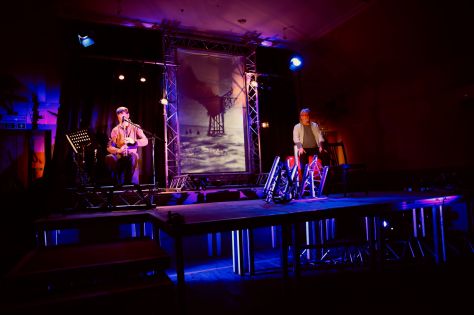
But, a show? A show is a very different thing. We called it a multi-media performance but it was a show. A show not a tell. A dialogue in the form of monologue that happens in its own space in the company of others immersed in an entanglement of music, light, sound, space.
I had always conceived of Pibroch ‘the show’ as a touring piece – a roving conversation migrating to whatever locality would listen and some that might not. I had a notion that this end would be best served by developing the show in a general-purpose social space: a community centre or church hall or, where I live, a village hall.

I had good personal reasons for settling on Glenbuchat. It is a magical place with a strong sense of community and a thriving music and arts scene based around local promoters and organisations like Glenbuchat Music, Eclectic Events and Art in the Buchat. Like all ‘remote’ locations it is the centre of its own universe with a particular can-do attitude and a generous soul.
But, for some of my professional theatre colleagues it must have seemed a perverse choice. No wifi, no public transport, allegedly no mobile phone signal (an unhelpful rumour). “Does it have running water”, one asked. Of course it does: fresh from the spring!
It did not have a flexible arrangement for rigging lights, a lot of electric power, a very big stage. And we had to accommodate COVID-19 restrictions when thinking about audience numbers, team accommodation and the arrangement of walkways.
The first time Simon Gane, Pibroch’s designer and production manager, looked at it, it was both exciting and daunting.

Challenge: how to create a special Pibroch world inside this space – a world that encompassed offshore oil platforms, hurricanes, rain forests, oceans and, indeed, the world itself.
We knew the show would depend heavily on projected imagery which complimented and added depth to the experience. We knew we would use sound effects and have the benefit of Fraser Fifield’s magnificent music to create and counter-point mood. But we had very little stage space and and every lighting-stand, stage-extension or set dressing ate into already limited audience capacity.
Simon, Brodie, Mark and Graeme went through many iterations negotiating a set design, lighting inventory and projection solution that satisfied as many of our aesthetic ambitions as possible. As a direct-address performance – poetry not theatre – Mark was insistent that Fraser and I (the poet-performer) be lit. But lighting needed not to wash-out the projected backdrop which must also be legible from the back of the hall. And it would be good not to trip the circuitry.
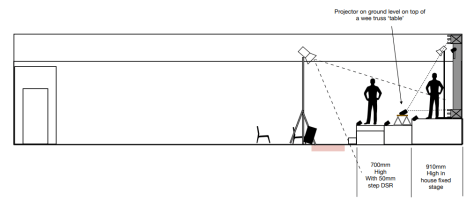
Simon’s eventual design was an elegant multi-variable optimisation and, for me, it was a huge satisfaction to be working on a stage with a sense of the scale of screen, my degrees of freedom and the location of the (well-managed) trip hazards. I realised I had not worked like this, in theatre, for over 35 years…whilst Mark reiterated that I was not an actor and we were NOT doing theatre.

It was at this point that various ‘random’ pieces of truss which seemed superfluous to the overall structure turned up. I had mentioned that I was keen to echo the sense of trusses on the fixed steel jackets of 1970s offshore oil platforms and especially the distinctive triangular bracing on Piper Alpha’s two remaining flare-booms. I didn’t realise, in the first few days of rehearsal, how effective these elements of Simon’s design would be. I was also sent to Banff to retrieve an oil drum…a stand-in for the eminence grease behind the production.
By Wednesday night, the show had a repertoire of gestures, moves, musical punctuation. A feel. Fraser and I did a complete run-through then left to allow Brodie and Martin Aitken, stepping in at the last minute, to rig the lighting and dress the set.
It was only as we worked through the tech, laboriously and meticulously setting levels and states, exploring transitions and balancing elements that I, at least, came to realise the richness of what we had created here. We had created a time and a space – a particular Pibroch-space in the specific real space of Glenbuchat Hall.
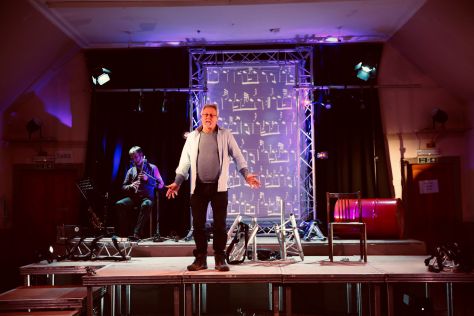
All that remained was to welcome an audience into that space and we did, ushering each into specific seating one metre apart. The first notes of Padraig Mor MacCrimmon’s Lament for the Children on Fraser’s pipes conjured a world.