
So ess is here – or hereabouts –
an aathing fae es pint o reference
transforms intil a pint o view.
Hadean is the first poem in the In-gangin sequence of Twilt. Hadean proposes a narrative of Earth’s prehistory from between 4.5 billion and 4 billion years ago.
The original poem is written in Doric Scots and was first published in Tales Fae the Doric Side [Doric Books, 2023].
Over the last few months, I have been working poems from the In-gangin section of Twilt into a sequence of film poems which were premiered at the Royal Geological Society’s Earth Canvas event in London in September 2024. The film-poem is now available on my You-Tube channel and will be followed soon by its 5 companion poems in the sequence.

Inspirations
The work builds on inspirations, insights and practices developed in creating a performed spoken word version of my Pibroch collection for touring in 2023. The show involved music from Fraser Fifield, based on a traditional source, and visual art generated by the author and sequenced and polished by Graeme Roger of Wildbird. The experience established, for me, the power of words, music, visual effects and conversation in co-creating an understanding of the world.
Pibroch begat Twilt and Twilt begat the Hadean film poem.
In creating the film, I was conscious that I was trying to create a scientifically plausible, imaginable and poetically meaningful proposition about Earth (Here) four billion years ago. The work extracts ideas and relationships from scientific papers and related public science publications and web-content. Though not featured in the current draft of Hadean, I used text analysis software to extract the geoscience vocabulary of the period and visualise the intensity of key ideas. Geek that I am, I downloaded available datasets, built graphs in order to visualise time series and relationships.

One small part of the inspiration of the Earth Canvas conference was the insight, for me, that geologists, like artists, propose a narrative based on the experience. They don’t – and can’t – impose a real world long since ‘past’. They imagine into a deep-time dynamic so that what is produced is a mix of the representation of NOW as maps and processes and a plausible narrative of how WE (as Earth) got here. Though experiments determine the gas content of ice cores or the geochemistry of minerals the subject matter is always shifting, distorting, recombining. This is not physics. Gravity is g but g is not stable or uniform. It drifts, there are anomalies. Yes: everything is physics, but variables change over time and the world must be recomputed again and again, often on the basis of sparse or incomplete data. Recomputed and reimagined, refreshed and performed.
World Building
Part of the standard vocabulary of fiction writers is ‘World Building’. How do you describe the imaginary world your protagonists interact within at any point in historical or imaginary time? Geoscientists engage in a similar project – though for them, perhaps, it is better labelled ‘World explaining’, and the agonists are inorganic as well as organic. And any case, the boundaries of inorganic and organic are in constant flux. Which is to say, there are no boundaries.
Beyond the video editing I had practiced in developing Pibroch, the challenge of creating meaningful and expressive imagery of a distant past and place led me to exploring 3D modelling (or CGI) using the Blender application. The learning curve was steep (and still is!). But, as well as online documentation and forums, there is a vast wealth of shorts, demonstrations and tutorials online. Blender animation has been applied to scientific & mathematical modelling as well as 2D cartoons, architectural design as well as Sci-Fi and Manga fantasies. The Blender community of practice have generated a vast range of add-ons, textures and ‘sub-routines’ in pursuit of their desire for realism and/or cinematic-realism.
Time
Which brings me to ‘time’. These world builders create nebulae, stars, planets, landscapes that look realistic and are essentially mathematically generated from scratch. Simulated worlds in which creatures and things are felt to interact ‘believably’ in time. They can simulate crystal growth or orogenies, erosion or deposition, volcanoes or tsunamis. Life forms, individual or in swarms. Noise and intention are skillfully, digitally and collaboratively blended. Whether in ‘Tolkien-Time’ or ‘Deep-Time’ or ‘Starwars Time’, their tools simulate what we think experience should look like in the given paradigm.
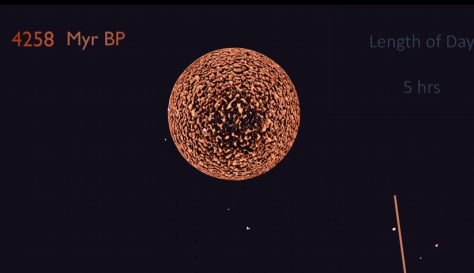
Hadean was the easy one to create. A cooling ball of lithic stuff with decelerating angular velocity. No more accurately hypothesised tectonic plates. No hydrosphere (to speak of) and no cryosphere. Not much in the way of atmosphere.
But the project raised profound questions about time for me. If an Earth day (period to rotate about its axis by 360 degrees) was 5 hours in the early Hadean Eon, was that really 4.3 billion years ago? Whose years? How many days to a year? [Yes: I know we can calibrate against atomic clocks but does this address relativistic issues?]

And eons, eras etcetera are vaguely defined based on progressive lack of hard data AND we have a perceptual bias towards stuff like us – Jurassic dinosaurs – rather than life on the edge of the inorganic. The stratigraphy isn’t set in stone.
Finally, writing a 2 minute poem about 500 million years of process demands selection, edit and abstraction. There is poetic time as well as deep-time as well as traumatic-time. Most of us find the birth of the moon or the KT event more interesting than the deposition of sediment over millenia.
I hope you enjoy this first instalment of Twilt in the link below. If you do, please like subscribe and comment in my Youtube Channel or below this post. Watch this space.
Credits: many scientific papers and articles were used in research for Ingangin but, especially for Hadean, I am heavily indebted to the work of Chris Scotese.