| Previous | Previous Date | Gaels | Next Date | Next |
There is nothing Bríd O’Boellain can do but keep the beasts inside and pray that the turf isn’t blown off of the roof. The storm has lasted for days.
At intervals, wee Sean or her Daide have to venture out into the lashing rain, the blast cold prising open their mantles to pierce through their lienes. The tussock wind is sharp with salt from the coast as they drag another hank of straw from the rick or turf from the stack. The trees shriek East, bent in submission before the Atlantic gale.
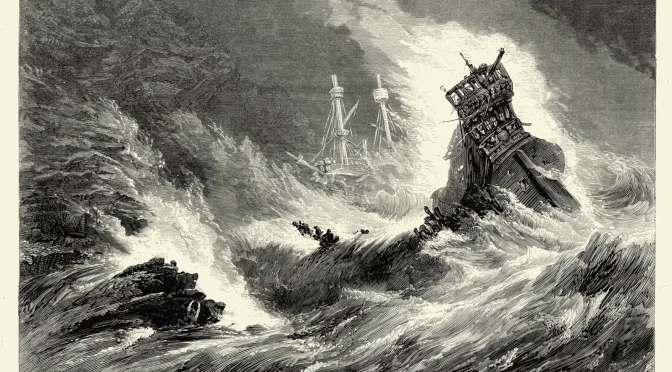
The rumour of invasion reached them before the storm’s intensity stamped out all concerns beyond holding on. Great ships had appeared just off the coast. Catholic ships presaging liberation from the Sassanacha.
Perhaps, her Daide wondered, the tempest was the Saviour’s intimidation, a prelude to the subjugation of the Sassanacha.[i]
Bríd’s boy, Sean, is nine. He was unintended; though Bríd was clear enough on what she wanted of Diarmaid O’Connor at the time. Diarmaid had intentions of his own but he was not of the marrying kind. What was she, after all, but a poor beauty humped behind a midden? Her father had a few cattle and a plot he rented from the O’Rourkes.
Still, Bríd is not so sure that hadn’t been a blessing.
While the storm rages outside, they huddle in the smoky bothán, well enough fed on smoked fish, crowdie and gruel. The hairst is in and the meal kists full as they will ever be.
On the morning of the fourth day, Bríd hears someone moving outside then Pádraig Óg calls through the wicket door.
“They are all destroyed!”
Her Daide rises from the hearth to shout through the door. “Who is destroyed?”
“The Spanish. Three big ships. All wrecked on the shore at An Stríthideach. Loaded with gold and jewels. Everyone is going. Don’t be a fool, Bríd. Come.”
Bríd glances across the hearth to her Daide, cocks her head, then rises to the adventure of it. “Let’s go! Seán,” she says, “You stay here and pay attention to the fire. Don’t let it out now.”
The North wind has moderated since midnight though it is still blowing cold. Grey cloud tumble across a lukewarm sky. Pádraig beckons towards the path through the bog to the spinney.
“It’s not for you.,” Daide says.
“Daide,” she says, “I’ll be the judge of that. But a wreck is a wreck.”
They follow Pádraig into the scrub and on across the rigs beneath Ben Bulbain.
“Jesus, Mary and Joseph!”[
Gaunt, naked men run towards them then, as if ashamed, shirk left and right to crouch shivering behind the slender birches. By their trimmed beards and close cropped hair they seem dapper men stripped to their skin. Dusky men. Not Irish. Fine trimmed beards but dishevelled. Some are wounded. All seem astounded.
“Spanish?”
The swarthy, lean, hard naked men cringe – fighting men ashamed as their gear and limbs like savages. Pádraig pressed on.
” Pádraig, wait!”[7]she shouts after him.
“These have already been stripped,”he says. “The bounty is on the beach. Wealth washed up like porpoises and there to the club.”
“Clubing?”
“Better take our share before the English come to capture it.”
Another Spaniard staggers into view. This one is dressed to the waist in sodden scarlet velvet though his thin linen trousers are stained with blood and shit. A fine specimen he is, though lame. He leans on a branch, dragging his left leg behind him.
“This one hasn’t been stripped,” she says as she moves left and Pádraig right to corner the fugitive.
“Cur!” Pádraig struck with his club, knocking the man back onto his arse.
“Merced. Por el amor de Dios”.
Brid observes the shivering man. His fine clothes seem outlandish. Pádraig presses his blade against the Spaniard’s throat.
“Pádraig.”
“What’s wrong with you, Spaniard?”
“¡Por favor! No tengo nada”.
Pádraig seizes the collar of the Spaniard’s doublet, tearing it open.
More naked men skirt their party, unwilling to come to their compatriot’s aid.
Brid catches up with Pádraig as her Daide stands watch. The Spaniard reeks of salt and fear. Pádraig cuts the laces on his velvet doublet, ripping open his white linen sark. Brid peels the doublet from the Spaniard’s shoulders as Pádraig rips open his shirt, exposing his chest. A fine chest, dusky and furred with black hair. The fellow gazes into her eyes as Pádraig rips the gold chain from his neck.
“It’s amazing that you didn’t drown with so much gold on you!”
The doublet is soaked in brine and heavy. She throws it aside, noticing the flash of silk and brocade cinched around his waist. She kicks him over onto his back, straddling his thighs as she tears at the brocade.
“¡Por favor!”
Pádraig stares at the chain. She rips the silk from the Spaniard. Pádraig thrusts once, his blade piercing the Spaniard’s neck.
“Let’s go. There’s more to it than this, Bríd!” he says, then disappears into the darkness, his face to the North West wind.
Delicate things grind and crunch within the silk sleeve in Brid’s hands. The Spaniard moans and whimpers, blood oozing from the wound in his shoulder. She opens the pocket in the sleeve to find bones and fabrics, amulets and relics.
“What are these?”
He doesn’t seem to understand. His hand presses on the bleeding wound.
“Bhríd. Let’s go with Pádraig,” her Daide says.
She has her knife. The Spaniard teeth are chattering.
“Help me get this off of him and then move on.”
When her Daide has followed Pádraig and the Spaniard is stripped of his linens, she asks. “What are these?”
He doesn’t understand.
“What are these, Spaniard?”
He will not say. But sure as bird bones and talismans, the relics in her hand are sacred and have kept him safe. Brid clenches them close and secures them in the pocket of her liene.
“I am a Christian,” she tells him. “Christian. Not a Lutheran heretic. Understand?”
He seems a fine enough specimin, ten years older than herself, shivering, naked. She nods to him then, picking up the heavy doublet, walking away towards the bothán, leaving him bleeding, his back against a scrawny birch.
Back at the bothan, Sean is tending the fire.
“Where is grandpa?”
“Gone with Pádraig to see what he can find.”
“But you came back?”
“Yes. Look!” She holds up the doublet for Sean to see then throws it down beside him at the hearth. “That’s worth something. And this.” She examines the vestment of silk and brocade. “And these are valuable.”
She hangs the crucifix on its silver chain around her neck. The chain is so long the crucifix rests between her breasts, the metal cool against her skin. Fragments of bone and fabric, torn parchment, a silver medal jostle in her pocket. She examines them in the smoke and firelight. Relics. Worth more than gold and silver to a soul.
Though much good they did the Spaniard unless, of course, they brought him this far when all his comrades drowned or have been butchered on the beach. Unless, Brid is their point.
“It’s lumpy.!”
Sean is exploring the sodden doublet as it steams in the warmth of the hearth.
” It will be an ornament, Seáin.”
“No,” the boy says. “Feel!”
Brid tests the place he indicated. Beneath the velvet something hard. Something small. Like a button but there is no button to be seen. There is, however, a seam.
The point of her knife picks at the thread.
“Mother of God! Holy Mary, Mother of God!”
The piece of gold glimmers in the hearth-light and the pale light filtering through the door. Her excited fingers search out the next and then another as if cleaning lice from a liene. She places the little stack of coins on the flat stone. Thinks of the Spaniard shivering in the wood.
“You get the rest, John. Seáin. And don’t tell Grandpa..”
The boy looks and sees and understands. By the time Brid has made up the poultice, Sean has found thirty-two crowns, half of which are still sewn into the fabric.
“A lot!” she says. She finds her Daide’s filthy other liene and a brat that belonged to her mother “Tar.”
When they return to the spinney, it is almost noon and the cloud is breaking. The Spaniard has crept into the ferns but she can hear his teeth chattering.
“Quiet,” she says. “This is my son. Seán.”
The Spaniard cringes her fingers pressed the salve into the open wound on his shoulder.
“It will help cure it.”
As she rubs, the Spaniard relaxes a little from his terror. When the poultice is applied, she offers him the liene, tugging it over his head. Then she has demonstrated how the brat should be worn, the fringe tugged up over the head like a hood, she throws the brat over the Spaniard’s shoulders.
“Gracias.”
“Sean. Take him as far as Ben Bulbain. No further. And speak for him. You understand. Tell anyone who asks that he is your daft Uncle. And avoid the English. Understand?”
Her son nods and she watches as they move off along paths Sean knows well enough, the boy leading the way and the Spaniard slogging after him, his weight supported by his branch.
“Strange days,”she thinks, then turns back towards the bothán to hide the crowns where no-one else would know before her Daide returns.
| Previous | Previous Date | Gaels | Next Date | Next |
[i] Sligo Ireland: Spanish Armada in Sligo; History, Heritage, Irish Folklore, and News from County Sligo, Ireland