Tag Archives: Piper Alpha

Imagine

Shakespeare takes the simple route in The Tempest. He has Miranda tell us that it’s ‘raining-out’.

If by your art, my dearest father, you have
Put the wild waters in this roar, allay them.
The sky, it seems, would pour down stinking pitch,
But that the sea, mounting to the welkin’s cheek,
Dashes the fire out.

But we already knew that by the predicament of the seafarers in Act 1, Scene 1.  There were portents and premonitions. 

Credit : NASA

In developing Pibroch, I was always conscious that this was a project that had to integrate many media and levels of discourse.  Its title conceit is musical but it is, centrally, a text – yet to research and shape the piece I found myself examining images. Images of hurricanes and bleached coral.  Images of drought and torrential rain. Graphs and infographics. News reports and mobile phone footage. Images from satellites and adverts for deluxe refuges in obsolete nuclear missile silos.

Credit : Survivalcondo.com

And, of course, the available images of Piper Alpha before, during and after the night of the disaster on 6th July 1988 – of survivors, rescuers, family members, Occidental’s promotional footage, the pontifications of Tory ministers and Oil Industry executives.

But then a hurricane is not climate change.  One cannot SEE climate change.  It’s a process.  Ida, Katrina or Tauktae are pixels in the pattern. To see the pattern we must learn to LOOK.

As I write, I can see the misty morning landscape beyond my window. I can see there is no sign of snow on this mild December day. If I chose to look, I could see news images of massive snowfalls in Northern California & Japan and floods in Malaysia.  And always the droughts and the malnutrition, the violence and migration. To quote from Pump, part of the first movement of Pibroch:

Out there on the horizon. 

Out there

later

not now

somewhere else.

Yet we are all collecting data.  In a sense we are the data.  Our experience and the way we jot things down – in selfies, snapshots, journal entries & witness statements, poems.  We are the evidence of climate change.  We (not I) integrate the ‘big picture’, join the dots, IMAGINE the process!

Don’t get me wrong.  It is not that the process is imaginary.  Climate Change is as real as we are.  But it is only in the vast collage of data and imagery, experience and empathy that it can be seen. Even the many manifestations of Climate Denial or Delay are part of that process.

But how does this, seemingly kaleidoscopic, array of images become the landscape of a show, the setting of Pibroch?  Make sense…or nonsense…of our current predicament?  For it can only be OUR predicament…not yours or mine.

Of course, there are ‘practical’ issues in producing the show: copyright and intellectual property rights.  Ethical issues of appropriation and exposure.  The balance of impact versus authenticity, accessibility versus facticity.  Not to mention the practicalities of bringing that visual language into the performance space with its real-world constraints of dimensions, lines of sight, lighting and power-sources. 

Credit : Simon Gane

But beyond these, I realised, there is a creative imperative to make the imagery FELT which demands LOOKING not just seeing.

And that, after all, is the primary discipline and virtue of graphic art – the necessity and wonder of looking. So, working closely with Graeme Roger of wildbird on the audio-visual design of Pibroch recently,  I have been forced to look again and, maybe for the first time, to look deeply at the imagery that has shaped the work, imagery that has shocked or saddened me, outraged or appalled. 

Infranodus Text Modelling

From calving icebergs to drowned children, remote sensing imagery of daily CO2 emissions to snaps of my parents’ wedding – how could we encapsulate, simplify and project these visual ideas into the performance space in ways that complement the words and music and the rapport between Arthur Coates and myself and the audience?

The visual design (so far) retains the text-mining maps I used to explore key texts like the Cullen Report or the various IPCC reports and includes public domain visualisations or satellite imagery of ‘global’ events. 

Credit : Peter Glenn

But the specific, FELT imagery – the subjective data-points tied to the expression of a refugee child, floodwater streaming through an Scottish village, crops shrivelled in desiccated fields and, of course, the twisted steelwork of Piper Alpha –  these images demanded to be looked at, felt, re-presented. In charcoal, mostly.  The recreation of my sense of this unfolding disaster scratched out in carbon.

What will survive into the finished piece on the 15th January will, of course, depend on a dense network of creative interactions and practical decisions over the course of the next few weeks, but the discipline, over the last few weeks, of sifting, simplifying and expressing these images has been immensely important.

The several ‘meditations’ on the Piper Alpha structure during and after the fatal explosions connect more viscerally to the burning and twisting, rupture and collapse – its angles and trajectories, the still seeping smoke, the amazement of flame as the riser ruptured.
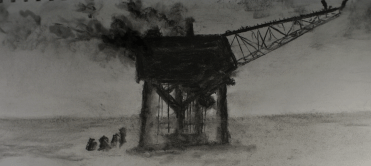
Piper Alpha 7th July 1988

And so too, the long meditation on children: how their faces might confront us in this adversity – in suspicion, rebuke, curiosity or shy laughter?  The struggle for likeness but more so expression – the quicksilver flux of emotion (and therefore meaning) ‘behind’ the face and ‘behind’ the process.

Whilst the blizzard of ‘found’ (or force-fed) imagery leads to an overwhelm which is, ultimately, dispiriting – the creative distillation of individual images into a collective/still-subjective felt-sense allows us to work through the data to deeper levels of knowing.  To levels which tap into kennings of love, grief, compassion, obligation.  I’ve said elsewhere, Poetry is Activism in making the predicament (more) felt.  So too then is image making and their reintegration into the work.

Pibroch at the Paisley Book Festival 2022

Join us at 3 pm on Saturday 19th February for a performance of Pibroch in my home town of Paisley as part of the 2022 Paisley Book Festival. Booking now open at the PBF website.

Credit : Paisley FM

Really proud to have a place in this programme. And in such fine company! Louise Welsh, Vahni Capildeo, Jenny Fagan, James Robertson, Graeme Macrae Burnet, Denise Mina & Kathleen Jamie! And yes…I’ve left a lot out. This is going to be a sizzling week of events in the heart of Radical Renfrew.

Epiphany on Hope Street

It’s over a week now since the parties to the Conference that was COP26 jetted or slogged back to their many points of origin.

Credit : GlasgowLive

In the interval, I’ve been processing the constructive disillusionment of the event, the necessary street theatre of protest, the sickening deafness of politicians and lobbyists, the vile taste of greenwash.

If there is reason to hope, it might lie in the fact that, at least this time, ‘they’ didn’t even promise to ‘save the world’ by keeping average temperatures below 1.5 degrees above pre-industrial levels in 2100. 

Credit : Climate Action Tracker

Projections, based on the agreements, suggest 2.7 degrees above pre-industrial levels is the best-case scenario.  As usual, those projections ignore many tipping points we might barge through in the meantime.  Assume that is an optimistic estimate.

So, they are content we are 1.2 degrees less safe than they promised in Paris in 2015. As they left, they promised they might promise next year…next time…maybe.

Which is not, believe me, cause for despair.  Many, many earnest folk committed to a better future prepared for COP26, showed up at COP26, tried to make their voices heard. 

I was in Glasgow for the last day.  An AcousticCommons radio initiative – As if Radio – had kindly invited me into the Civic House studio for a chat about ‘Poetry as Activism’, Pibroch and my views as a former ‘fossil-fuel industry insider’.  Too weary to ‘slog’ home to Aberdeenshire (on the bus) that night, I stayed over at an excellent ‘affordable’ hotel in the Finnieston.  On the Saturday morning we discovered that the bureaucrats were still fudging and evading whilst suggesting that pulling an all-nighter was somehow ‘above and beyond’ their job-descriptions.  “It’s only a mass extinction event, after all!”

In the breakfast room, my fellow low-budget ‘parties’ discussed and debated in Spanish, Danish, Quechua, Japanese, Xhosa and, of course, the cargo language… English, whilst two awesome women negotiated and renegotiated, in Scots, the niceties of a full Scottish breakfast – ‘haggis, black pudding AND a tattie scone?’ – with the intrigued, the principled and the down-right hungry.

“Worst fortnight o ma life, so it wiz!” she said to me. “Still, whit can ye dae?”

To avoid climate catastrophe?  Negotiate, renegotiate, compromise…don’t compromise.  Listen.

“Jist the eggs an the tattie scone then?  Whit aboot beans?”

Maybe it was the worst fortnight of many of our lives…so far.  Yet a few miles from the conference centre at Finnieston, the world seemed ‘normal’.  A bit quieter than usual, they said.  Like Glasgow was holding its breath…or under martial law…high viz policing in twos and threes on all the major thoroughfares.

Between the radio interview and the hotel, I stepped in for a dram and a scribble at the Pot Still.  Afterwards, at the Number 3 bus-stop on Hope Street, I bumped (in a socially distanced way) into a young Canadian woman and her mother.  The younger woman was incensed that the previous Number 3 had driven past her.

“He saw me.  He shook his head and just kept driving.”

I shrugged it off with native indulgence : “Glasgow. What can you say?”

They weren’t in Glasgow for the COP.  The younger woman was studying in Glasgow and her mother had come over to visit.  They had been to Edinburgh that day.  We had the standard exchange about the pronunciation of ‘burgh’ in Scots.

Four minutes before the next Number 3 was due, they lost patience and called an Uber.

“Places to be and things to do,” she said as the Uber pulled into the bus-stop and blocked the way for the Number 3 which pulled up simultaneously.

Over the previous week I had been reading David Graeber and David Wengrow’s book, The Dawn of Everything.  In it the authors propose three fundamental freedoms:

The freedom to move

The freedom to disobey

The freedom to redefine social relations

Fundamental freedoms that few in the modern world possess.  As I sat on the number 3 to Drumchapel, the brilliance of the moment exploded in my imagination.  The young Canadian’s body language, the way she hailed the bus, the way the driver of the previous Number 3 exercised, in that moment, his freedom to move, to disobey and to redefine social relations by driving straight past her. 

Ay, gaun yersel, Glesga!

At 2.7 degrees above pre-industrial levels, billions of creatures, human and otherwise, will find themselves in conditions of untholeable heat or rising water-levels, starvation or violent conflict.  And, of course, for many it will not be either-or.

The freedoms to move, to disobey, to redefine social relations have never been so vital.  The survivors on Piper Alpha on the night of 6th July, 1988 exercised exactly those freedoms.  They left the ‘temporary refuge’ in which they had been urged to remain.  They broke with procedure and the chain of command.  They re-asserted their humanity – their fundamental freedoms – and jumped. And on the sea-below, others – bosuns, ordinary seamen – waited, heroically, to rescue them, drag them to safety, give them aid and comfort.

In that sense, there is hope in the dismal fudge of COP26. Might it be the tipping point in which we realise we need to be free to live?

Pibroch at the Paisley Book Festival

Pibroch is a spoken-word performance that blends words, music and striking visual imagery to examine parallels between the Climate Emergency and the Piper Alpha Disaster of 1988. Exploring the responses of people trapped on a ‘burning platform’, Pibroch is grounded in author John Bolland’s personal experience of working in the offshore oil and gas sector and his conviction that only radical change can moderate the impacts of climate change in ways that are just, sustainable and meet the needs of ordinary folk in their communities. The performance will be accompanied by music from Fraser Fifield and followed by a creative conversation, in which audience members will be encouraged to explore themes associated with the work.

This show has been developed with the support of funding from Creative Scotland based on the text of John Bolland’s second collection, Pibroch, forthcoming from Red Squirrel Press.

It’s ALIVE… poetry festival

Coming up next week! The Wee Gatherin, an ‘in real life’ poetry mini-festival organised by The Poet’s Republic in venues around Stonehaven in the North East of Scotland.

Poets are coming in from Scotland, Ireland and England for an opportunity to read, share, laugh…and probably drink.

First event in the bill will be a world premiere reading of poems from the new collection, Pibroch, which will be published by Red Squirrel Press in September…but I can’t wait to share work I’ve been focussed on for the last 2 years.

Pibroch explores parallels between the Piper Alpha disaster in 1988 and the unfolding climate catastrophe driving the extreme weather events occuring with increasing frequence and fatal consequences. The title alludes to the pibroch Lament for the Children (Padraig Mor McCrimmon c1640).

The poems in Pibroch have been created as a mix of found poems and imaginative voicings based on :

  • The extant official enquiry and documentation associated with the disaster (e.g. the Cullen Report, Cabinet Papers, newspaper articles);
  • Interviews in the public domain from survivors and relatives;
  • Emotional, behavioural and scientific parallels between the disaster and the current climate crisis as documented in various intergovernmental reports and scientific papers.

As a former oil worker, a scientist and a climate activist, I feel the tensions between my responsibility for the situation, my empathy for the working men and women involved in the fossil fuels industry over the past century and my fears for the future of my children, grandchildren and the sustainability of most of the life on the planet.  It is widely recognised that swift action is needed to mitigate and adapt-to the evolving ecological crisis.  Pibroch is my attempt to engage with the lived experience of the last three generations in both the global North and South in promoting the need for a genuinely Just Transition.

For me, the parallels between the unfolding climate crisis and the events around the 1988 Piper Alpha disaster are striking. It’s a common place to say radical change demands a ‘burning platform’.  In Piper Alpha there is a well-documented concrete metaphor for the emerging catastrophe which requires critical reflection and vivid, accessible expression. On the night of 6th July,1988, 167 men died and 47 survived.  Two weeks ago, around 500 people died on the West Coast of North America. This week, over 150 lost their lives & livelihoods in extreme flooding in Germany, Belgium and the Netherlands.

Every year, thousands are forced to flee in the face of environmental degradation and the conflicts provoked by hunger, thirst and poverty arising from the climate emergency.

Perhaps the work can best be summarised by the poem Teach Your Child to Swim. One of a number which will be featured in the Wee Gatherin reading.