The Pibroch Collection, published by Red Squirrel Press, will be launched into this big wide world at Avant Garde on Monday 21st. Copies available from this website, Red Squirrel Press or on the night. Looking forward to a great night reading with Stirling Makar, Laura Fyfe launching her pamphlet The Truth Lies and Helen Boden launching her collection A Landscape to Figure In. And playing sax into the bargain.
As I write, Simon Gane and Brodie Murray are moving the truss for the staging up to the venue at Glenbuchat. This afternoon is the get in. The prequel to a week of rehearsal and, eventual, performance.
Over the last week I’ve been very conscious of the shift in effort and attention to detail involved in putting on a performance of this type.
Yes: I am used to the finnicky detail of editing poems – the notorious shifting and re-shifting of commas and nuancing of words – and the even greater scrutiny involved in proofing, typesetting and design. I have been blessed with a great publishing team in Sheila Wakefield, Elizabeth Rimmer and Gerry Cambridge at Red Squirrel Press who share a passion for perfection and vast amounts of patience.
And I am familiar with the excruciating attention involved in printing and painting – especially in portraiture – where a millimetre displacement or an increment of hue can make or break a piece.
But, as a writer and visual artist, I’ve never had to worry much about COVID risk assessment, feeding the crew, the availability of First Aiders: let alone whether anyone can actually see or hear me!
Glenbuchat Hall, a real space
And yet here Pibroch is, in a real space – Glenbuchat Hall in West Aberdeenshire – at a real time – a Saturday night in January in the second year of a global pandemic – working with real people – performing to real people – with musical accompaniment by Fraser Fifield and visuals developed in collaboration with Graeme Roger – in a setting created by Simon Gane.
And we are ready and it has come together through the skills and effort of all of the team, not least the directorial inputs of Mark Thomson, the support of Martin Aitken, marketing nous of Lucy Stroud and mentoring of Lesley-Anne Rose of Open Road Ltd.
The journey from idea to text to a visual concept has been long but these last weeks have been intense. How do we make these ideas and elements play, in an exciting and engaging manner, within the real space? Where do I stand? How do I avoid getting in the way of projection? Am I lit – visible – audible – ‘appropriate’?
I began with naïf assumptions about the space – especially the stage – the options for lighting and projection (and exit routes and social distancing) but, day by day, the team has solved and resolved each issue – proposing, critiquing, collaborating, reworking.
Vertical Projection in Growth
A key design decision was to use a vertical rather horizontally aligned projection mode (think portrait rather than landscape). This played off of the available stage area and the projector throw necessary to achieve appropriate height to width ratios.
And the stage footprint – and no-go zones defined by the projection beams – constrained the lighting opportunities and, as I am sure will emerge, where I can actually ‘be’ on the stage at any moment in the performance.
Our decision not to use a stage mic frees me from the stand – and the simplifying constraint of a single narrow footprint as in cabaret performance. But now I am interacting with the lights, the projection beam and the challenge of not falling off the stage whilst speaking the text in a relaxed, powerful and (ideally!) coherent and audible manner. Hmm. I’m not sure I’m in Kansas anymore.
I have previous theatrical experience – I know how to find a light and follow notes – project and present. But, after almost a decade of working and performing as a poet and spoken word performer, it feels like this new project has taken my experience and practice to a new level of discipline and sophistication. All of which I owe to the Pibroch team who have acted not only as enablers to the work but patient mentors in each aspect of the craft. They have my eternal gratitude.
It was an idea and now it’s possible…and that is the art. A week from now we will be striking the set in that space and looking for future programming opportunities for Pibroch through 2022.
I have been working on this project since Autumn 2019 and I can honestly say – I am excited!
Watch this space for more updates as the week progresses.
It has been a long and fascinating journey bringing Pibroch to the stage and to publication with the generous help and support of fellow writers, musicians and, of course, my publisher. So, deep gratitude to Imogen Stirling, Hamish Napier, Elizabeth Rimmer, Mark Thomson, Sheila Wakefield & Gerry Cambridge of RedSquirrel Press & Lesley Anne Rose of Open Road Ltd. And, of course, Creative Scotland and the National Lottery for funding to develop the show.
So privileged now to have a great creative team on board to carry on taking the project to fruition.
Mark Thomson – Co-Director
Mark was Artistic Director of the Royal Lyceum Theatre Company from until June 2016 during which time he directed over twenty-five productions including world premieres of Donna Franceschild’s Takin’ Over the Asylum, D C Jackson’s The Marriage of Figaro, Jo Clifford’s Every One and adaptation of Goethe’s Faust parts one and two, Six Black Candles by Des Dillon, John Byrne’s Uncle Varick as well as his own plays: A Madman Sings to the Moon, Pinocchio, his adaptation of James Hogg’s The Private Memoirs and Confessions of a Justified Sinner and, in 2011, Wondrous Flitting. In 2015 he directed The Caucasian Chalk Circle which won 4 CATS awards and earned him a nomination for Best Director at the UK Theatre Awards. His production of Waiting For Godot starring Brian Cox and Bill Paterson was nominated for several categories including Best Director and won Best Production at the CATS.
Mark Thomson
Prior to his time at the Royal Lyceum, Mark was Artistic Director of the Brunton Theatre Company, directing 21 shows and winning a Herald Angel Award for his play A Madman Sings to the Moon, and a Scotsman Fringe First and a Herald Angel Award for his play Moving Objects.
He has also worked as Assistant Director at the Theatre Royal Stratford East and the Royal Shakespeare Company and Associate Director at Nottingham Playhouse.
He now works as a Freelance Director, directing several productions for the Royal Conservatoire of Scotland and leads the MFA in Directing and MFA Acting Course at Napier University.
As well as co-directing Pibroch in 2022, Mark directed the premiere of D C Jackson’s I’m dissolving my love in a bath of acid. for Play. Pie and a Pint with Shetland’s Alison O’Donnell.
When not fretting over theatre Mark plays in his band The Bail Sheriffs and cycles in all weathers.
Fraser Fifield – Composer & Musician
Fraser Fifield
Brought up in West Aberdeenshire, Fraser started playing bagpipes at the age of 11, taking lessons from his GP in Aboyne, Aberdeenshire. Since then, he has made music with a wide range of artists covering folk, jazz and beyond. His instrumental choices – pipes, saxophone and low-whistle – partly accounting for his exploratory style which sits astride several genres. He has performed on low whistle, saxophone and bagpipes with many artists including Salsa Celtica, Old Blind Dogs, Afro Celt Sound System, Zakir Hussain, Ayanna Witter-Johnson, Capercaillie, Balkanopolis, Nedyalko Nedyalkov, BBC SSO, Gavin Marwick, Kathleen McInnes, Graeme Stephen, Rieda Morrison, Patsy Reid, Karine Polwart, Maeve McKinnon & Montenegro Eurovision 2015.
As well as performing in #PibrochthePlay , Fraser has been busy in 2022: touring with Graeme Stephen in Austria and Scotland, with Tom Bancroft’s ‘In Common’ in Egypt and performing at the Barbican, London, as part of the memorial concert for the late John Cummings. He also started a new 3 year role as Traditional Artist in Residence at University of Edinburgh.
Described by the Scotsman as ‘one of today’s outstanding talents’, his latest album, Piobaireachd, was released in 2021.
John Bolland – Writer, Co-Director & Performer
John Bolland managed parallel careers in writing and in the offshore oil & gas industry for almost 35 years. Scientifically trained but instinctively an artist, John writes novels, poetry and short fiction in Scots and English and is a graduate of the University of Glasgow’s Creative Writing Masters programme. Between 1982 and 2014, he held a number of project management and consultancy roles for clients including BP, Exxon-Mobil and Shell. During 2018-19 he was a Regional Organiser for Extinction Rebellion and is currently active in the North East Scotland Climate Action Network (NESCAN). His poetry and short fiction has been widely published and his first collection – Fallen Stock – was published by Red Squirrel Press in 2019. The companion collection to the Pibroch performance was published by Red Squirrel in 2021. He is a director of the Scottish Writers’ Centre, chair of Huntly Climate Action and a trustee of the Dee & Don Ceilidh Collective.
John Bolland
Work inspires work. As well as planning for the 2023 tour, John has been working on two new projects: Twilt and Improvement Notice. Both works were prompted by after show discussions following Pibroch‘s 2022 performance and a realisation that “we must reimagine our past in order to be able to radically reimagine our future.”
Simon Gane
Simon Gane – Production Manager & Designer for Pibroch
Simon is a freelance Designer and Production Manager based in the North East of Scotland. He trained, in his hometown, at the Bristol Old Vic as a Technician a few more years ago than he now cares to remember. Simon worked as a venue-based Technical Manager for many years, notably at TIC TOC in Coventry and The Lemon Tree in Aberdeen. Gaining a wide experience of many genres and disciplines, he was resident Lighting Designer at the Lemon Tree in Aberdeen for a number of years before leaving the world of a secure salary to forge a more creative path. Since then, he has been managing productions and designing lighting & small sets, mainly for Scottish dance companies with occasional excursions back into theatre and music. His production management and design expertise has enabled him to realise productions inside & outside, site specific, nationally and internationally.
Like the rest of the team, Simon has been busy in 2022, generally making one end of the room brighter and a bit more organised than the other. Simon has provided lighting designs for NYDCS’ ’Sounds Like’, Suzi Cunningham’s ‘Eidos’ & ‘Rules to Live by’, Y Dance Destinations and Project Y, Daniel Lorenzo’s ‘Red Land’ Katie Armstrong’s ‘ GLISK’ & ‘SKETCHES’ Sharon Took-Zozaya’s ‘ Finding Petunia Little Tree’, Raw Material’s ‘Unicorn Christmas Party’, and SCO’s ‘Immersive’. In parallel, Simon’s Production Manager hat has been well worn in support of James Ley’s ‘Ode to Joy’, Dance Live Festival 2022, Sound Festival 2022, Pete Stolery’s ‘Aberdeen Sound Park’ for Wonderland and the Deeside Dance School Showcase 2023.
Martin Aitken
Martin Aitken – Producer
Martin Aitken is a multi-disciplinary arts practitioner based in the North-East of Scotland. Much of Martin’s work is rooted in the city of Aberdeen, telling local stories or working with local creative organisations and youth theatres. Initially trained in technical theatre, Martin is keen to use his knowledge in the industry to produce new work and support local artists to tell their stories. Recently Martin has also been exploring alternative outlets for his creativity, releasing two children’s books last year with a third due for release in early 2022.
Graeme Roger – Audio-Visual Design
Graeme Roger is a visual artist working across film, public art, performance, photography, installation & theatre. All his projects are collaborative in nature with other artists, musicians, directors and the wider community. His work has been shown nationally and internationally. He has created video designs for companies including The National Theatre of Scotland, Eden Court Theatre and C21 Theatre, often creating design for projections in public spaces and galleries.
Graeme Roger
Graeme is the Engagement Producer for Film & Visual Arts Projects at Eden Court Theatre in Inverness and leads the digi team on the Scottish Government’s ‘Cashback for Communities’ programme. http://www.wildbird.org.uk/
Karen Tennent – Set & Costume Design
Karen lives in Edinburgh Scotland and is a graduate of Edinburgh College of Art. Her work as a theatre designer has toured all over the UK and abroad from village halls to Sydney Opera House. She enjoys collaborating with other artists, exploring live performance in its many forms. Her design experience includes devising and designing physical theatre, theatre for young audiences, touring and in house productions as well as large scale site-specific and promenade performances.
Karen Tennent
Recent designs include;
Don Quixote (Dundee Rep/Perth heatre ) by Ben Lewis: director Lu Kemp
MusterStation (Gridiron/Edinburgh International Festival 2022 )
Field- something for the future now an outdoor dance performance by Curious Seed (Edinburgh International Festival 2021 and Festival Cultura Inglesa Sao Paolo, Brazil 2022 ).
Lots Not Lots (Made in Scotland/Summerhall 2022 ) by Greg Sinclair and Hannah Vent .
Rubble (Scottish Opera), a new opera by Johnny McKnight and Gareth Williams for Scottish Opera Young Company
The Children (Dundee Rep) by Lucy Kirkwood directed by Andrew Panton
And if not Now ..When an film installation by Philip Pinsky and Karen Lamond in the National Museum Edinburgh for COP 26.
Christmas Dinner (Lyceum Edinburgh) by Rob Evans directed by Gill Robertson
Karen co-directed Sonata for a Man and a Boy (Greg Sinclair) which won the CATS best Children’s Theatre. She also won CATS best design and was nominated for the New York Drama Desk Awards for Outstanding Design for Hansel and Gretel (Catherine Wheels).
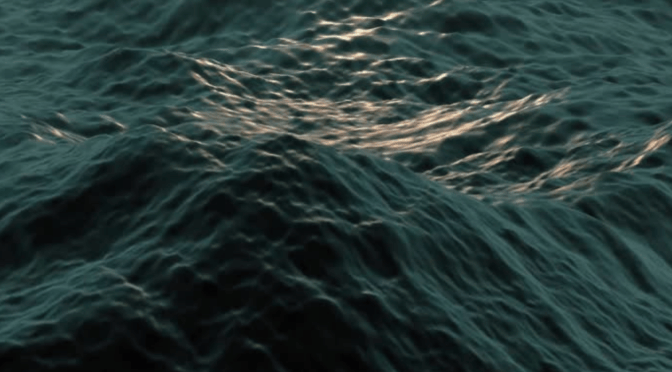
Shakespeare takes the simple route in The Tempest. He has Miranda tell us that it’s ‘raining-out’.
If by your art, my dearest father, you have Put the wild waters in this roar, allay them. The sky, it seems, would pour down stinking pitch, But that the sea, mounting to the welkin’s cheek, Dashes the fire out.
But we already knew that by the predicament of the seafarers in Act 1, Scene 1. There were portents and premonitions.
Credit : NASA
In developing Pibroch, I was always conscious that this was a project that had to integrate many media and levels of discourse. Its title conceit is musical but it is, centrally, a text – yet to research and shape the piece I found myself examining images. Images of hurricanes and bleached coral. Images of drought and torrential rain. Graphs and infographics. News reports and mobile phone footage. Images from satellites and adverts for deluxe refuges in obsolete nuclear missile silos.
Credit : Survivalcondo.com
And, of course, the available images of Piper Alpha before, during and after the night of the disaster on 6th July 1988 – of survivors, rescuers, family members, Occidental’s promotional footage, the pontifications of Tory ministers and Oil Industry executives.
But then a hurricane is not climate change. One cannot SEE climate change. It’s a process. Ida, Katrina or Tauktae are pixels in the pattern. To see the pattern we must learn to LOOK.
As I write, I can see the misty morning landscape beyond my window. I can see there is no sign of snow on this mild December day. If I chose to look, I could see news images of massive snowfalls in Northern California & Japan and floods in Malaysia. And always the droughts and the malnutrition, the violence and migration. To quote from Pump, part of the first movement of Pibroch:
Out there on the horizon.
Out there
later
not now
somewhere else.
Yet we are all collecting data. In a sense we are the data. Our experience and the way we jot things down – in selfies, snapshots, journal entries & witness statements, poems. We are the evidence of climate change. We (not I) integrate the ‘big picture’, join the dots, IMAGINE the process!
Don’t get me wrong. It is not that the process is imaginary. Climate Change is as real as we are. But it is only in the vast collage of data and imagery, experience and empathy that it can be seen. Even the many manifestations of Climate Denial or Delay are part of that process.
But how does this, seemingly kaleidoscopic, array of images become the landscape of a show, the setting of Pibroch? Make sense…or nonsense…of our current predicament? For it can only be OUR predicament…not yours or mine.
Of course, there are ‘practical’ issues in producing the show: copyright and intellectual property rights. Ethical issues of appropriation and exposure. The balance of impact versus authenticity, accessibility versus facticity. Not to mention the practicalities of bringing that visual language into the performance space with its real-world constraints of dimensions, lines of sight, lighting and power-sources.
Credit : Simon Gane
But beyond these, I realised, there is a creative imperative to make the imagery FELT which demands LOOKING not just seeing.
And that, after all, is the primary discipline and virtue of graphic art – the necessity and wonder of looking. So, working closely with Graeme Roger of wildbird on the audio-visual design of Pibroch recently, I have been forced to look again and, maybe for the first time, to look deeply at the imagery that has shaped the work, imagery that has shocked or saddened me, outraged or appalled.
Infranodus Text Modelling
From calving icebergs to drowned children, remote sensing imagery of daily CO2 emissions to snaps of my parents’ wedding – how could we encapsulate, simplify and project these visual ideas into the performance space in ways that complement the words and music and the rapport between Arthur Coates and myself and the audience?
The visual design (so far) retains the text-mining maps I used to explore key texts like the Cullen Report or the various IPCC reports and includes public domain visualisations or satellite imagery of ‘global’ events.
Credit : Peter Glenn
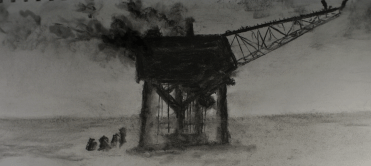
But the specific, FELT imagery – the subjective data-points tied to the expression of a refugee child, floodwater streaming through an Scottish village, crops shrivelled in desiccated fields and, of course, the twisted steelwork of Piper Alpha – these images demanded to be looked at, felt, re-presented. In charcoal, mostly. The recreation of my sense of this unfolding disaster scratched out in carbon.
What will survive into the finished piece on the 15th January will, of course, depend on a dense network of creative interactions and practical decisions over the course of the next few weeks, but the discipline, over the last few weeks, of sifting, simplifying and expressing these images has been immensely important.
The several ‘meditations’ on the Piper Alpha structure during and after the fatal explosions connect more viscerally to the burning and twisting, rupture and collapse – its angles and trajectories, the still seeping smoke, the amazement of flame as the riser ruptured.
Piper Alpha 7th July 1988
And so too, the long meditation on children: how their faces might confront us in this adversity – in suspicion, rebuke, curiosity or shy laughter? The struggle for likeness but more so expression – the quicksilver flux of emotion (and therefore meaning) ‘behind’ the face and ‘behind’ the process.
Whilst the blizzard of ‘found’ (or force-fed) imagery leads to an overwhelm which is, ultimately, dispiriting – the creative distillation of individual images into a collective/still-subjective felt-sense allows us to work through the data to deeper levels of knowing. To levels which tap into kennings of love, grief, compassion, obligation. I’ve said elsewhere, Poetry is Activism in making the predicament (more) felt. So too then is image making and their reintegration into the work.
World Premiere of Pibroch, a spoken-word show exploring parallels between the Climate Emergency and the Piper Alpha Disaster of 1988.
This show has been developed with the support of funding from Creative Scotland based on the text of John Bolland’s second collection, Pibroch, forthcoming from Red Squirrel Press.
Coming up next week! The Wee Gatherin, an ‘in real life’ poetry mini-festival organised by The Poet’s Republic in venues around Stonehaven in the North East of Scotland.
Poets are coming in from Scotland, Ireland and England for an opportunity to read, share, laugh…and probably drink.
First event in the bill will be a world premiere reading of poems from the new collection, Pibroch, which will be published by Red Squirrel Press in September…but I can’t wait to share work I’ve been focussed on for the last 2 years.
Pibroch explores parallels between the Piper Alpha disaster in 1988 and the unfolding climate catastrophe driving the extreme weather events occuring with increasing frequence and fatal consequences. The title alludes to the pibroch Lament for the Children (Padraig Mor McCrimmon c1640).
The poems in Pibroch have been created as a mix of found poems and imaginative voicings based on :
The extant official enquiry and documentation associated with the disaster (e.g. the Cullen Report, Cabinet Papers, newspaper articles);
Interviews in the public domain from survivors and relatives;
Emotional, behavioural and scientific parallels between the disaster and the current climate crisis as documented in various intergovernmental reports and scientific papers.
As a former oil worker, a scientist and a climate activist, I feel the tensions between my responsibility for the situation, my empathy for the working men and women involved in the fossil fuels industry over the past century and my fears for the future of my children, grandchildren and the sustainability of most of the life on the planet. It is widely recognised that swift action is needed to mitigate and adapt-to the evolving ecological crisis. Pibroch is my attempt to engage with the lived experience of the last three generations in both the global North and South in promoting the need for a genuinely Just Transition.
For me, the parallels between the unfolding climate crisis and the events around the 1988 Piper Alpha disaster are striking. It’s a common place to say radical change demands a ‘burning platform’. In Piper Alpha there is a well-documented concrete metaphor for the emerging catastrophe which requires critical reflection and vivid, accessible expression. On the night of 6th July,1988, 167 men died and 47 survived. Two weeks ago, around 500 people died on the West Coast of North America. This week, over 150 lost their lives & livelihoods in extreme flooding in Germany, Belgium and the Netherlands.
Every year, thousands are forced to flee in the face of environmental degradation and the conflicts provoked by hunger, thirst and poverty arising from the climate emergency.
Perhaps the work can best be summarised by the poem Teach Your Child to Swim. One of a number which will be featured in the Wee Gatherin reading.
Thwaites Glacier – West Antarctica, 28th Dec. 2019 – NASA Earth Observatory
Tomorrow night – 11th February 2020 – sees the
inaugural event in STEM Poets programme of workshops and readings aimed at
developing a coherent and effective body of poetry and other writing which can
engage with and influence the outcomes of the ongoing Climate Emergency.
STEM Poets as a group was initiated by Eveline Pye in 2019
engaging a range of poets with a background, or special interest in Science,
Technology, Engineering or Mathematics. They support STEAM, a global initiative
to introduce the arts within STEM education in order to encourage creativity
and break down barriers between the arts and sciences. STEM poets believe it is
important that readers are presented with factually correct and truthful STEM
knowledge in works of imagination, specifically poems and short fiction, and
wish to promote informed writing on climate change. They want to encourage more
people to write about STEM subjects and will offer support and review of STEM
content. I am very pleased to count
myself as one of their number.
Tomorrow night’s event will involve a discussion between
Eveline and Colin Will, exploring some of the ideas and issues around Climate
Change poetry, many of which have been outlined in Eveline’s recent essay
published by Glasgow Review of Books.
The issues around STEM poetry and climate are, at even a
cursory exploration, complex and fascinating.
How is the complexity of biophysical processes communicated clearly and
coherently in ‘verse’ – as opposed to their natural vernacular of algebra and
algorithms? How do we as poets and
scientists avoid bowdlerising reality in order to get an essentially political
point across?
Eveline’s essay explores guidance of ‘effective
communication’ on Climate Change from a number of government and academic
sources which, in summary, propose that effective climate change poetry ‘should’:
“
i) be clear, relevant and
coherent avoiding references which are unlikely to be understood by the general
public;
ii) not rely on evoking fear either for the reader or the next
generation but should evoke positive emotions which support people’s internal
sense of agency – the feeling that their actions are meaningful;
iii) not be overly strident as this increases the likelihood that
the message will be discounted or ignored, and should avoid highlighting the
difference between the reader’s attitude and actions since this is more likely
to change their attitude than their actions;
iv) focus on past loss and the restoration of what has been lost,
near-term benefits and opportunities to avoid future losses rather than apocalyptic
scenarios;
v) help overcome negative associations and poverty attributions
associated with actions we want to encourage such as buying second-hand
furniture and clothes, drinking tap water and using public transport.
Talk about squaring the circle!
Having been active and interested in this area over the last
decade, I find these criteria challenging in the extreme in the context of a
single poem or even collection.
How to express the complexity – and often counter-intuitive
nature – of processes avoiding references ‘unlikely to be understood’?
How to avoid frightening or shaming individuals into apathy
or denial?
How to avoid advocacy in a literature which is, no matter
your perspective – whether a denier, a mitigator or an adaptor – partial and political?
And how to present positive inducements in a situation
which, ‘scientifically’, seems to forecast few upsides for human societies or
the majority of other critters currently on the planet?
In this context, this project does not need individual poets
but a community of poets – with diverse (precise but necessarily limited) STEM
knowledge and a range of political and
aesthetic perspectives on this process.
There are those who see rewilding as a ‘good’…others, perhaps, the
preservation of a material ‘civilisation’ (for some) at great cost to other
creatures and fellow-human beings. Some,
in workshops and discussions, have been sanguine and of the view that a world
without people would be a ‘good thing’…bring on the next mass extinction! Let us start again. The planet will recover…and it will (whatever
that means?). (And who are ‘we’ in that ambition?)
All of the above are essentially political perspectives –
not scientific – and should be expressed and explored clearly and coherently in
an accessible literature – doing what poetry and fiction do best – exploring alternative
personal perspectives and trajectories – but staying close to the topic. That the climate IS changing and will have
many complex ramifications for all living things and their social connection.
One of the areas I am working on, at the moment, concerns
the Thwaites Glacier, part of the West Antarctic Ice Shelf which extends ‘into’
the Amundsen Sea. Thwaites Glacier is
melting AND calving at an accelerating pace due to complex hydrological and
physical processes which, though perfectly ‘logical’ confound the simple notion
that ‘ice melts’.
Essentially, studies suggest, warm water (well… 1.5 degC) is
being hosed towards the grounding line of the ice shelf by canyons in the
seabed (themselves relics of earlier glaciation). The warm water (Circumpolar Deep Water),
which ‘flows’ out of the Northern hemisphere, undercuts and destabilises the
ice, which is NOT floating but grounded on the sea bed hundreds, sometimes
thousands of metres down. Melting from below
and subject to bending stresses it calves, releasing fragments to the open
ocean which float north (and melt).
So…make a poem out of that (working on it!) The episode highlights the gap between
school-child physics (ice melts at 0 degC in some slow dripping process – like an
ice-cube in a glass – as the global temperature inches up through 1.5 degC to 3
degC above pre-industrial levels) and the complexity of geophysical processes
in the ‘real world’. In fact, local
geophysical processes are directing jets of warm water at the grounding line
and the thinning ice is collapsing. Think of a high-powered water jet rather than
dripping meltwater.
It is estimated that Thwaites Glacier could account for 0.4m
of mean sea-level rise.
So,
What does 0.4m sea level rise mean? And when might that happen?
How do I have agency in addressing this issue –
reduce my GHG footprint? Throw up sea-defences? Both?
Does the poet addresses the consequences or
the process – a nostalgic grieving over things I’ve never seen or experienced
but are about to be ‘lost’?
I am drawn back to one of my creative
touch-stones in this, advice attributed to the Chinese Song Dynasty poet and
scholar, Wei T’ai.
‘Poetry presents the thing in order to
convey the feeling. It should be precise about the thing but reticent about the
feeling. ‘
I am very much looking forward to tomorrow
night’s event at the CCA in Glasgow and an ongoing collaboration with fellow
writers and artists in this vital area. Hope
to see you there.